SHAKIR ANSARI

AI Agents for Travel & Tourism Customer Service Automation

Travel agencies and tourism companies handle the same high-volume tasks every day: answering trip inquiries, following up on bookings, updating customers with itinerary changes, sending reminders, and managing travel documents. These repetitive workflows can slow response times, overwhelm teams, and weaken customer experience.

AI Agents for Travel & Tourism change that by automating customer service processes end-to-end—while still supporting human oversight where it matters most. Instead of replacing your systems, AI automation works alongside your existing tools (CRM, booking platforms, email, ticketing, spreadsheets, and internal workflows) to reduce manual effort and improve consistency.

Why Customer Service Is the Differentiator in Travel

In tourism, customers expect fast, accurate answers and timely updates—especially during planning and after booking. Even short delays can lead to:

  • Lost leads (customers move on to faster competitors)
  • Lower conversion rates (unclear timelines, missing details)
  • Higher support load (same questions repeated across channels)
  • Poor customer experience (late or inconsistent responses)

A modern Customer Service strategy for travel should focus on speed, personalization, and reliability—across email, website chat, WhatsApp, and phone support workflows.

What “AI Automation” Means for Travel Customer Service

In practice, AI automation for travel customer service typically includes:

  • AI agents that understand customer requests, ask clarifying questions, and route tickets
  • Workflow automation that updates CRM records, triggers emails, and schedules follow-ups
  • Generative responses for itineraries, FAQs, and support updates (with controlled sources)
  • Reminders and document handling for checklists, confirmations, and travel-related files

When designed correctly, AI agents help your team handle more conversations without increasing headcount.

How AI Agents for Travel & Tourism Work (Simple View)

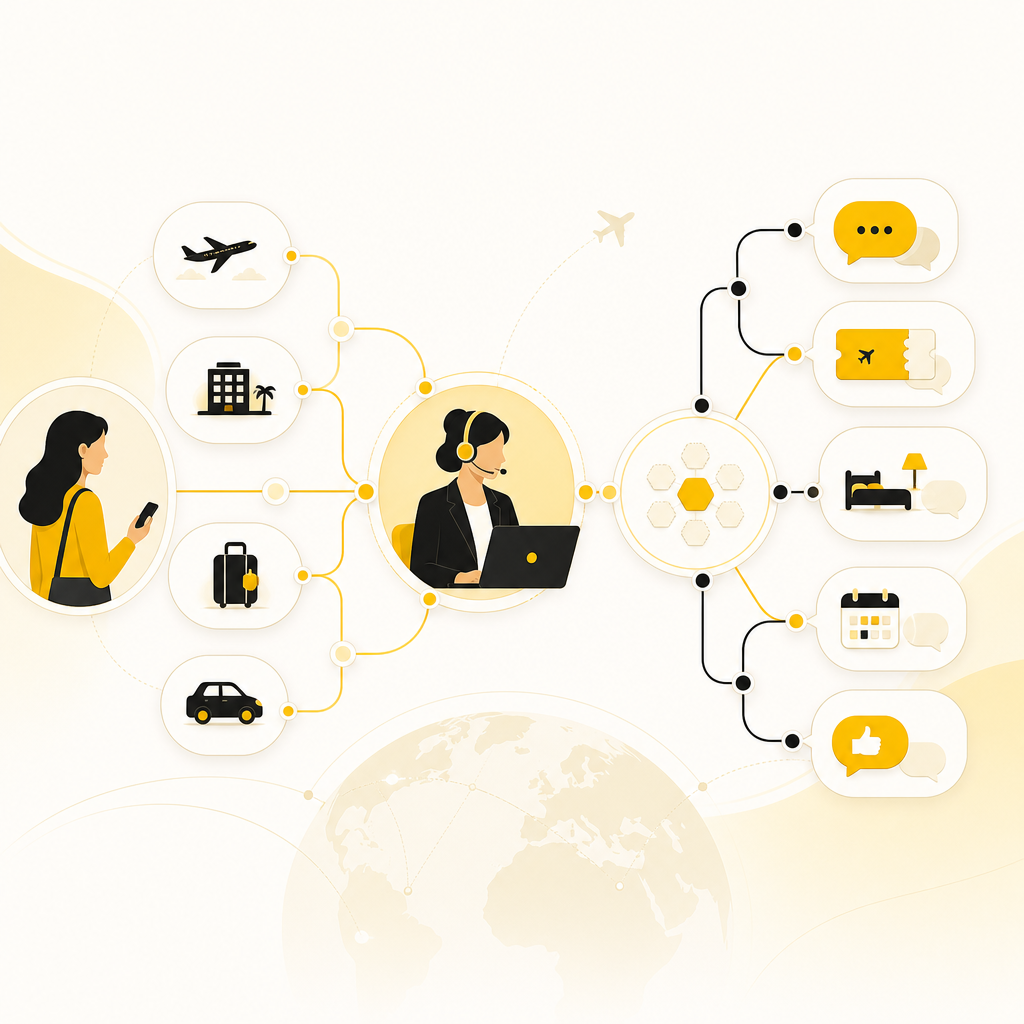
A travel support AI agent usually follows this flow:
  1. Intake & context
    • Captures inquiry details (dates, destination, group size, preferences, budget signals)
    • Detects intent (new trip inquiry vs. booking support vs. itinerary changes)
  2. Decisioning & workflow execution
    • Chooses the right next action (create a lead, request missing info, check booking status, start a follow-up sequence)
Abstract connected workflow nodes representing travel customer service intake and decisioning in gold and near-white tones with no readable text.

  1. Response & customer communication
    • Replies with a draft itinerary, next-step questions, or support guidance
    • Sends updates through the same channel the customer used (email/chat/etc.)
  2. Integration & system updates
    • Writes structured data back to your CRM
    • Logs the conversation in ticketing/support systems
    • Triggers email sequences and reminders
    • Prepares documents or checklists based on the trip
  3. Human handoff when needed
    • Escalates complex cases (refund issues, edge-case policies, special assistance)
    • Keeps your agents in control and informed

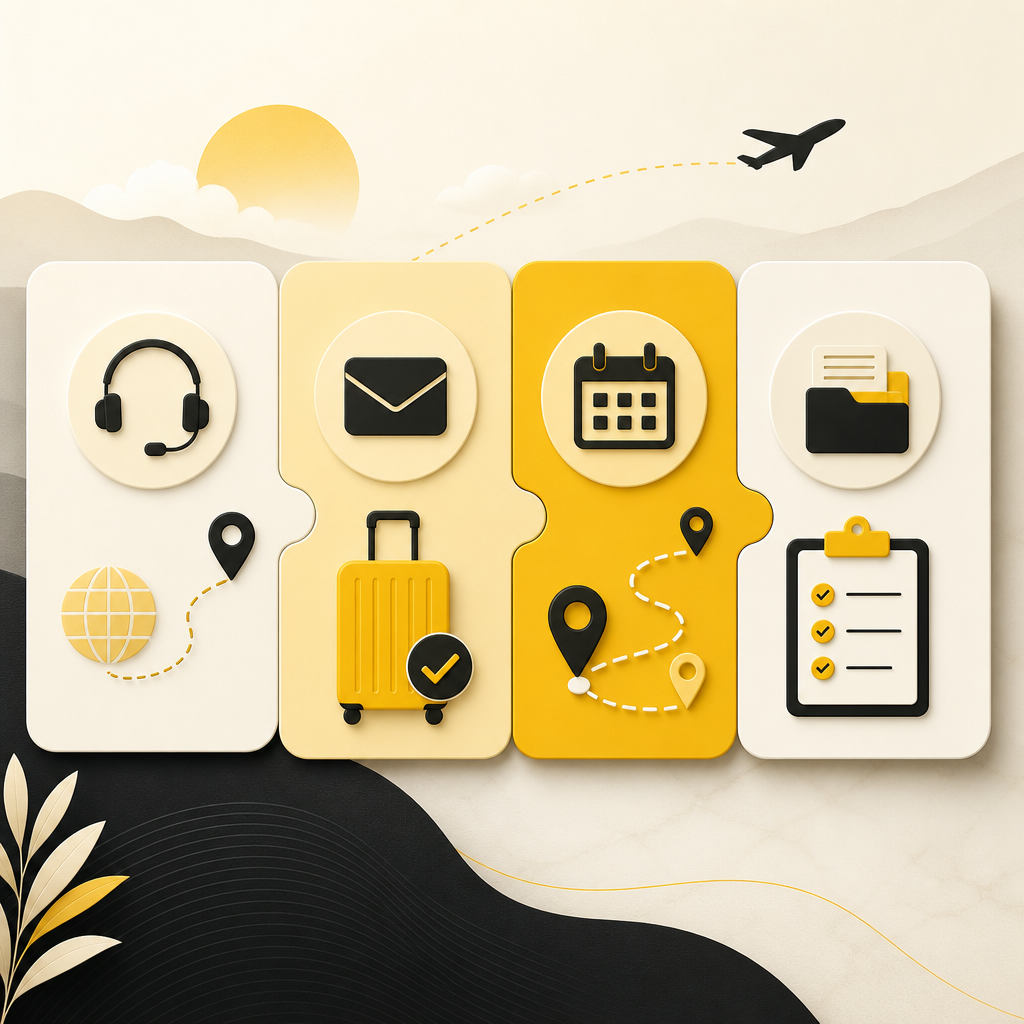
Interlocking travel customer journey panels with calendar, envelope, and checklist style icons in gold and near-white tones, with no readable text.

High-Impact Use Cases for Travel Customer Experience

1) Automate Trip Inquiries (Without Losing Personalization)

AI can handle first contact instantly, collecting the right trip details and producing a structured inquiry record.

Examples:

  • Ask the customer the exact missing details (travel dates, room type, pickup needs)
  • Generate a tailored response: “Here’s what’s possible for your dates” + next questions
  • Create/assign leads in your CRM automatically

Result: faster replies, higher lead conversion, and cleaner pipelines for your sales team.

2) Booking Follow-Ups That Run in the Background

After a customer books (or goes halfway through the booking flow), follow-ups are often where teams fall behind.

AI automation can:

  • Confirm booking details and send clear next steps
  • Follow up when payment is pending
  • Notify customers about changes (timing updates, schedule revisions)
  • Nudge customers to provide required information

Result: fewer “Where is my confirmation?” messages and a smoother booking journey.

3) Customer Support for FAQs and Common Service Requests

Travel customers ask similar questions repeatedly: cancellations, baggage rules, pickup instructions, weather/season guidance, hotel check-in times, visa document checklists, and more.

An AI agent can:

  • Answer FAQs using your approved policies and knowledge base
  • Provide step-by-step guidance
  • Collect details for support tickets and route them to the correct team

Result: reduced repetitive workload and consistent customer service quality.

4) Itinerary Generation and Itinerary Updates

Itineraries are a major part of the travel customer experience—and they change.

AI can help your team by:

  • Generating draft itineraries from trip inputs (dates, preferences, pacing)
  • Formatting itineraries consistently (day-by-day structure)
  • Updating itinerary sections when customers confirm or modify details
  • Summarizing changes clearly for customers

Result: faster turnaround from inquiry to itinerary, and fewer manual edits.

5) Reminders That Reduce No-Shows and Confusion

Reminders improve customer experience by preventing missed deadlines.

AI automation can schedule and send:

  • Pre-trip reminders (check-in instructions, meeting points)
  • Document due dates and submission reminders
  • “Day-of” messages aligned with each itinerary segment

Result: fewer last-minute requests and fewer operational surprises.

6) Document Handling (Checklists, Generated Files, and Retrieval Workflows)

Document handling in travel often involves multiple steps: collecting information, preparing confirmations, maintaining templates, and sharing files.

AI agents can support:

  • Generating trip-specific checklists (e.g., essential travel documents by destination)
  • Producing structured confirmations and packing guidance
  • Extracting key fields from provided details (when appropriate)
  • Routing document requests and tracking completion status

Result: cleaner document workflows and less time spent managing files manually.

Building Blocks: What to Integrate for a Real Travel AI Agent

To deliver reliable AI Agents for Travel & Tourism, you typically connect:

  • CRM & lead tracking (so inquiries become structured opportunities)
  • Booking and scheduling tools (so the AI can reference real statuses)
  • Email and chat channels (so the conversation continues naturally)
  • Support/ticketing systems (so issues are logged and escalated correctly)
  • Knowledge base and policies (so responses stay accurate and consistent)
  • Document templates and internal procedures (so outputs match your brand and process)

The most effective implementations focus on workflow execution, not just chat.

Ensuring Quality: Accuracy, Safety, and Human Control

Great customer experience depends on trust. A travel AI agent should include safeguards such as:

  • Human handoff for complex or sensitive requests
  • Source-controlled answers using your policies and approved content
  • Validation steps for booking-critical details
  • Conversation logging so teams can review and improve the system
  • Fallback paths when the AI is uncertain (and clear next steps for customers)

This approach improves customer experience without risking misinformation.

Practical Implementation Roadmap (For Travel Teams)

Step 1: Start with one workflow that creates the biggest support load

Common starting points:

  • Trip inquiry intake
  • Booking follow-ups
  • FAQ customer service coverage

Step 2: Define what the agent can and can’t do

  • What information it can request
  • What actions it can trigger (CRM updates, emails, reminders)
  • When it must escalate to a human
A layered roadmap blueprint of travel automation steps using geometric guardrail and handoff motifs in gold and near-white tones, with no readable text.

Step 3: Connect your systems and standardize your data

AI agents perform best when they can write to the tools you already use and pull the right context.

Step 4: Launch with guardrails and measure outcomes

Track improvements like:

  • Faster first response time
  • Reduced repetitive inquiries
  • Higher lead follow-up completion
  • Improved customer satisfaction indicators
  • Lower manual admin workload

Step 5: Expand to itinerary generation, document handling, and multi-step journeys

Once core workflows work reliably, expand to higher-value automation.

How Shakir Ansari – Full Stack Developer & AI Automation Solutions Can Help

If you want AI automation that supports your existing operations (instead of disrupting them), a custom implementation is often the best route.

Shakir Ansari and the RTP team can build custom AI automation solutions for travel businesses, including:

  • AI agent chat/workflows for customer service and inquiry handling
  • CRM updates and lead routing powered by structured extraction and automation
  • Email and reminder workflows tied to trip stages
  • Itinerary and document generation based on your inputs and templates
  • API integrations that connect your current tools and reduce manual work

Customer Experience Metrics to Watch

To prove impact on Customer experience, monitor:

  • Response time (first reply and resolution speed)
  • Conversion rate from inquiries to bookings
  • Follow-up completion rates
  • Ticket volume for repeat questions
  • Customer feedback quality (clarity, helpfulness, timeliness)

AI agents should make every customer interaction feel faster and more consistent—without sacrificing accuracy.

FAQs

What are AI Agents for Travel & Tourism?

AI agents for travel are automated assistants that understand customer requests, answer questions, collect key trip details, trigger workflows (like follow-ups and CRM updates), and escalate complex cases to humans when needed.

Can AI handle trip inquiries and still feel personalized?

Yes. A well-designed travel AI agent can ask targeted questions, use your trip rules/templates, and produce tailored responses based on the customer’s inputs (dates, destination, preferences, group size, and budget signals).

Will AI replace my customer support team?

In most travel operations, AI improves the customer support team’s capacity rather than replacing it. The goal is to automate repetitive work and free your team for exceptions, high-value requests, and cases requiring human judgment.

How do AI agents improve customer service in travel?

They reduce manual delays by providing instant responses, automating follow-ups, updating systems automatically, and delivering consistent guidance across common FAQs and support requests.

What integrations are needed to automate booking follow-ups and reminders?

Typically, AI agents integrate with your CRM, booking/status tools, email/chat channels, and support workflows so they can trigger the right messages and update records at the right time.

How do you ensure accuracy for itinerary and support responses?

Accurate implementations use controlled knowledge sources (policies and approved content), validation steps for critical details, and human handoff paths for uncertain or sensitive requests.

Conclusion

For travel businesses, Customer Service is inseparable from Customer experience. AI Agents for Travel & Tourism help you automate the repetitive workflows that slow teams down—trip inquiries, booking follow-ups, FAQs, itinerary drafting, reminders, and document-related steps—while keeping human support in control where it matters.

If you’re looking to build smarter, workflow-driven automation, explore AI Automation solutions that connect your existing systems and reduce daily manual effort.