
SHAKIR ANSARI

Full-Stack Booking & Automation for Tourism and Hospitality

Tourism and Hospitality businesses compete on speed, service quality, and guest experience. When bookings, payments, customer messages, and operations live in separate systems (or in spreadsheets), teams waste time, miss leads, and struggle to scale.

This pillar page explains how full-stack development—combined with SaaS Development and automation—helps hotels, travel companies, venues, and event businesses create connected, modern booking and communication platforms built for growth.

Why Tourism and Hospitality Teams Need Custom Full-Stack Systems

Off-the-shelf tools can help initially, but they often fall short when you need deeper integrations and tailored workflows—such as:

  • Booking flows that match your packages, availability rules, and capacity constraints
  • Automated confirmation and follow-ups across email/SMS/WhatsApp
  • Payment processing that reduces friction and chargeback issues
  • Admin dashboards for reservations, customer history, and operational updates
  • API connections to tools you already use (or plan to use)

With custom software development services, you can build a single digital system that supports your entire guest journey—from inquiry to check-in (or event arrival)—while improving internal efficiency.

CTA: If you want a system tailored to your property, packages, and workflow, explore custom full-stack development with Shakir Ansari.

Abstract map-like connections linking hospitality bookings, availability rules, and communications using warm gold and near-white tones.

What Full-Stack Development Means for Hospitality Businesses

Full-stack development builds both the frontend (what guests and staff use) and the backend (the logic, data, and integrations that make everything work). For Tourism and Hospitality, that typically includes:

1) Guest-Facing Experiences

  • Booking / reservation forms designed for conversion
  • Clear availability and pricing logic
  • Account or guest profile experiences (optional)
  • Messaging entry points (support, pre-arrival questions, upsell prompts)

2) Staff & Admin Dashboards

  • Reservations management (status, notes, changes, cancellations)
  • Customer view (history, preferences, tickets/messages)
  • Operational workflows (housekeeping coordination, schedule updates, event checklists)
  • Reporting for performance tracking

3) Robust Backend Services

  • Business rules (capacity, seasonal pricing logic, booking policies)
  • Secure data handling and role-based access
  • Integration layer for third-party tools

Core Modules to Build: The “Booking + Automation” Stack

A hospitality-ready platform usually includes several connected modules. The goal is to remove manual work and keep guest communication consistent.

Booking Engine & Availability Logic

  • Room/product selection (hotels, apartments, experiences, event packages)
  • Real-time availability logic (or near real-time with sync rules)
  • Booking policies (cancellations, modifications, no-show rules)
  • Confirmation workflow and reservation lifecycle tracking

Payments & Order Management

  • Payment integration for deposits and/or full payment
  • Order status tracking tied to booking states
  • Receipts, invoices, and payment confirmations
  • Refund and change workflows (where supported)

Customer Communication Automation

  • Automated confirmations (email/SMS/WhatsApp)
  • Pre-arrival instructions and reminders
  • Post-event or post-stay follow-up messages
  • Ticket routing and message history for support continuity

Customer Profiles & CRM-Style History

  • Preferences and communication logs
  • Repeat guest experiences (faster check-in / personalized offers)
  • Admin visibility into past interactions

CTA: Want to connect bookings, payments, and customer communication into one workflow? Learn how Shakir Ansari builds end-to-end systems.

Layered modular tenant panels connected by a central orchestration concept in warm gold and near-white tones.

Where SaaS Development Fits: Scalable Platforms for Multiple Properties or Brands

Not every hospitality business needs a SaaS product—but many do when they:

  • Manage multiple locations/properties
  • Operate as a booking provider/aggregator
  • Want to offer booking tools to partners
  • Need a standardized platform that scales across teams

In SaaS Development, the architecture is built for scale and multi-user access patterns. Common SaaS considerations include:

  • Multi-tenant design (separate data and configuration per client/partner)
  • Role-based permissions for staff, managers, and partner admins
  • Centralized updates (improvements rolled out without rebuilding everything)
  • API-driven integrations for partner ecosystems
  • Analytics dashboards per tenant

If you’re building a booking platform intended for growth across locations or customers, a SaaS approach can reduce long-term operational friction.

AI Automation for Hospitality: Reduce Manual Work, Improve Response Times

AI doesn’t replace human service—it helps teams respond faster and operate more consistently. In Tourism and Hospitality, AI-powered automation can support:

  • Smart customer support routing (classify inquiries: booking changes, availability, refunds, amenities)
  • Automated FAQs and draft replies to reduce support workload
  • Personalized recommendations based on preferences and booking history
  • Operational triggers (e.g., send check-in instructions when a booking reaches a specific status)
  • Conversation summaries for internal teams (so staff don’t repeat themselves)

When paired with workflow automation and reliable integrations, AI becomes a practical productivity tool—especially during high-demand seasons.

CTA: Explore AI automation and workflow automation options for your bookings and customer service.

API Integrations: Connecting Your Booking System to the Right Tools

The fastest way to improve operations is to connect your platform to what you already use (and what your business ecosystem requires). A full-stack hospitality system often integrates with:

  • Payment gateways and payment status webhooks
  • Email/SMS/WhatsApp messaging providers
  • Calendar and scheduling tools
  • Maps/location services
  • Analytics and marketing platforms
  • Channel managers / partner systems (where applicable)
  • Internal tools (PMS-like systems, reporting tools, support systems)

An integration layer built by experienced software development services reduces duplicated data entry and prevents mismatched reservation states across systems.
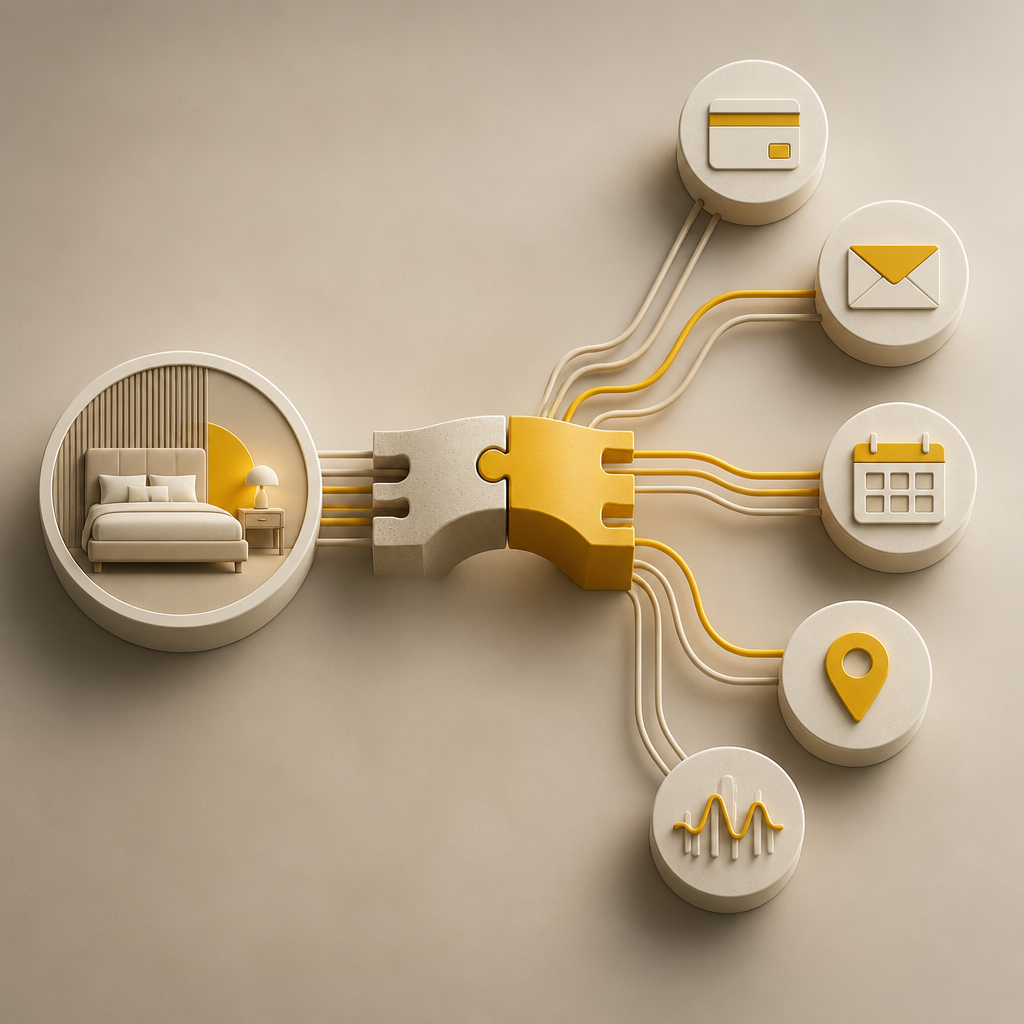
Abstract integration bridge linking payment, messaging, scheduling, mapping, and analytics concepts with warm gold accents.

A booking system should be designed around the user journey—not just functionality. Common high-performing flows include:

  1. Find → Choose → Book
    • Clear product/room cards
    • Transparent policies and booking rules
    • Fast booking form completion
  2. Book → Confirm → Prepare
    • Immediate confirmation messaging
    • Check-in instructions or event arrival details
    • Automated reminders based on timelines
  3. After Booking → Support
    • Ticket creation from a message thread
    • History visible to staff
    • Faster resolutions and fewer repeat questions

Full-stack development ensures these journeys work reliably across devices and staff workflows.

How Shakir Ansari & the RTP Team Approach Full-Stack Tourism Projects

Shakir Ansari and the RTP team deliver custom-coded digital solutions built for real operational needs. With 10+ years of experience and 1300+ web applications developed, the team helps Hospitality, Travel, and Event businesses build scalable platforms with strong foundations.

Typical outcomes supported by their process:

  • Custom websites and web applications tailored to your booking workflow
  • API integrations that connect third-party tools reliably
  • SaaS-ready platforms when multi-tenant scaling matters
  • AI-powered automation to reduce repetitive manual work
  • Clean, scalable systems that support long-term growth

CTA: If you want a tailored booking and automation platform, explore Shakir Ansari’s full-stack development capabilities.

What to Look For in a Full-Stack Development Partner (Hospitality-Focused)

When evaluating software development services for Tourism and Hospitality, consider asking:

  • How do you plan the booking workflow and availability rules?
  • What’s your approach to payment integration and order status reliability?
  • How will customer communication be automated and tracked?
  • Can you build dashboards for staff operations and reporting?
  • How do you manage API integrations and webhook events?
  • What does QA/testing look like for booking-critical features?
  • How will you support improvements after launch (iterations, new features)?

A partner that understands both hospitality workflows and modern engineering practices will help you avoid costly rework later.

FAQs

1) What is full-stack development for hotels and travel businesses?

Full-stack development builds the entire platform end-to-end: guest-facing booking experiences, staff/admin dashboards, backend services that handle rules and data, and integrations for payments and messaging—so the system works as one connected workflow.

2) Do we need SaaS Development for our hospitality business?

You may need SaaS Development if you’re building a platform intended to scale across multiple properties, partners, or clients, or if you want a configurable multi-tenant system rather than a single-property custom app.

3) How does AI automation help with customer communication in tourism?

AI automation can help classify and route inquiries, draft responses, trigger messages based on booking status, and provide faster support coverage—while maintaining consistent communication and improving response times.

4) What integrations are most important for booking systems?

Common high-value integrations include payment gateways, messaging providers (email/SMS/WhatsApp), scheduling/calendar tools, analytics platforms, and any channel/partner systems relevant to your operations.

5) Can you build a custom booking system instead of using templates?

Yes. Custom development allows you to implement your specific booking rules, policies, packaging logic, and staff workflows—without forcing your business into a rigid template.

Conclusion

For Hospitality, Travel, and Event businesses, a modern booking system isn’t just a form on a website—it’s an interconnected digital workflow. With full-stack development, you can unify booking, payments, staff operations, and customer communication into one reliable system. With SaaS Development (when needed), you can scale across properties and partners. And with AI and workflow automation, you can reduce manual work while improving response speed and guest experience across the journey.

CTA: Learn more about building a tailored full-stack booking and automation platform with Shakir Ansari.