
SHAKIR ANSARI
Hospitality teams juggle dozens of repetitive requests every day: guest questions, booking changes, check-in instructions, special requests, housekeeping coordination, and post-stay review follow-ups. When these tasks live in separate tools and inboxes, response times slow down and staff spend more time “copy/pasting” than solving.
AI automation helps hotels and guesthouses reduce manual work by using AI-powered chat, workflows, and integrations to route requests, update systems, and keep communication consistent—without forcing you to replace your existing tech stack.
This pillar page covers practical, end-to-end AI automation workflows for hospitality businesses, plus how to implement them with custom integrations and reliable escalation to your team.
In hospitality, AI automation typically combines:
Instead of one person managing multiple “threads” across channels, AI automation centralizes the request, understands intent, and executes the next best step.
Based on industry discussions and research on AI in hospitality, the most consistent benefits include:
Below are practical AI automation use cases aligned to real hotel guest journeys and internal operations.
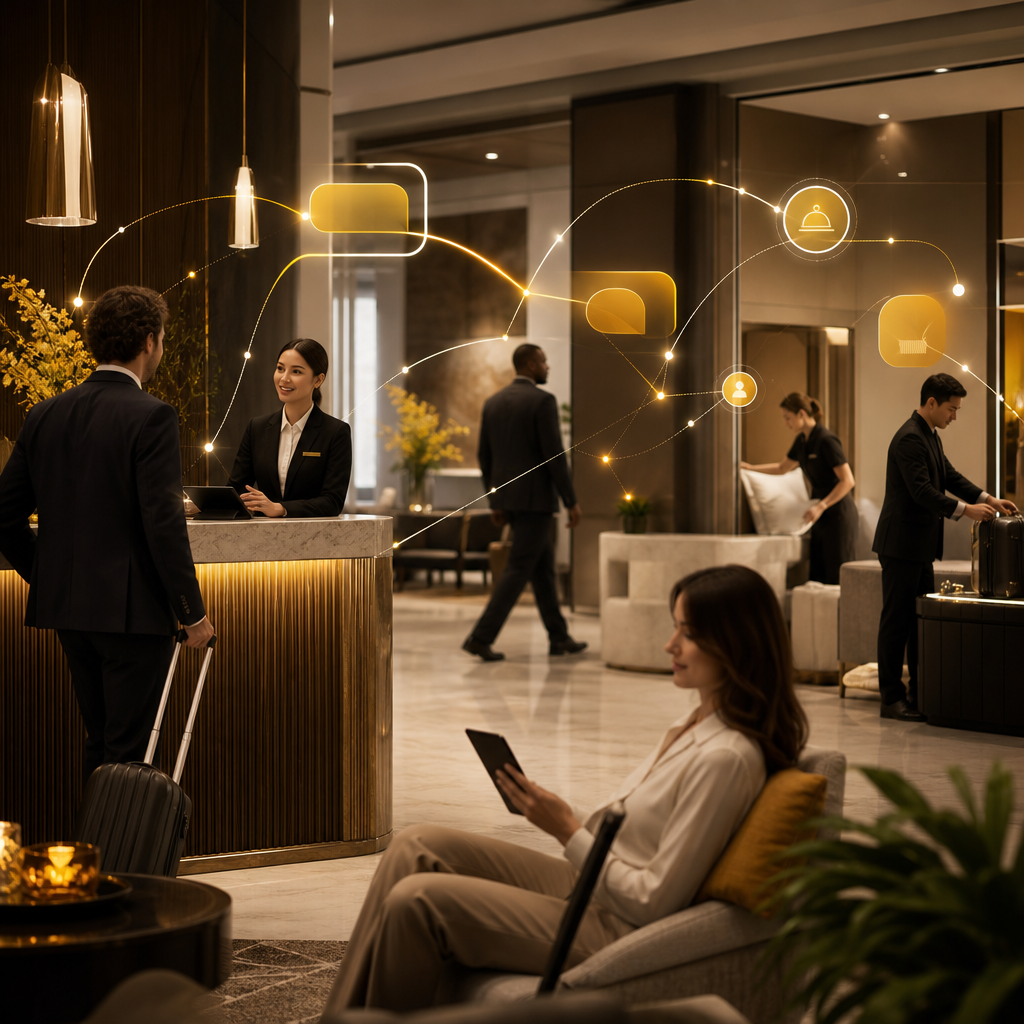
Goal: Respond instantly to common questions and collect the right details before staff involvement.
Common guest inquiries to automate:
How it works:
Key requirement: Build a safe workflow that logs requests and routes them to the right team when the AI needs confirmation.
Goal: Reduce manual back-and-forth for booking modifications and confirmations.
Automations to consider:
Integration pattern:
This is where custom AI automation shines: the system should act on real booking data—not guess.
Goal: Send accurate pre-arrival and check-in instructions automatically.
Typical automated messages:
How AI helps beyond templates:
Goal: Increase review volume and quality while keeping communication respectful and compliant.
Workflow examples:
Best practice: The AI should never “invent” outcomes; it should use booking/stay timestamps and your review policy. For sensitive cases, it should escalate with full context.
Goal: Prevent operational chaos by turning guest needs into the right internal tasks.
Examples:
AI role:
Goal: Reduce spreadsheet-heavy and repetitive admin work.
Automations to streamline:
Instead of “collecting data manually,” AI can compile it automatically from your integrated systems.
Industry discussions often highlight AI’s role in operational efficiency—including recruitment and internal workflows. For hospitality, that can translate into:
This is optional, but it follows the same principle: AI helps manage repetitive steps reliably.

Hospitality businesses rarely want to rip out their PMS, booking engine, or existing inbox workflows. The best approach is integration-first:
This reduces risk and ensures your AI automations stay aligned to your real operations.
A reliable setup usually includes:
Below are pattern-based case studies you can use as a starting point for planning your own builds. (Your actual results depend on your property setup, staffing model, and integrations.)

Problem: Guests ask the same questions repeatedly; staff respond inconsistently.
AI automation implemented: FAQ knowledge base + intent recognition + fallback to staff.
Outcome pattern: Faster initial responses and fewer repetitive tickets for common topics (parking, Wi-Fi, check-in times).
Problem: Booking changes require manual review and multiple message threads.
AI automation implemented: Reservation-aware responses and structured updates to internal systems.
Outcome pattern: Reduced back-and-forth and clearer communication for guests when changes occur.
Problem: Feedback arrives late or gets missed; negative experiences don’t reach staff quickly.
AI automation implemented: Checkout-triggered review messages + sentiment/urgency detection + internal routing.
Outcome pattern: More timely feedback capture and faster resolution paths for urgent issues.
Problem: Guest requests reach staff late or get lost across departments.
AI automation implemented: AI extracts details (room/time/issue) and creates tasks for housekeeping/maintenance/front desk.
Outcome pattern: Better operational response and fewer “handoff failures.”
If you’re building custom AI automation for hospitality, success depends on more than deploying a chatbot. You need an implementation that supports your workflows and data rules.
When Shakir Ansari and the RTP team build automation solutions, the focus is typically on:
Yes. The goal is to automate repetitive steps and route complex requests to your team with full context (booking details, request content, and recommended next steps).
It should—using an integration-first approach. The implementation is designed around your current systems so AI layers on top without disrupting operations.
A strong hospitality setup uses:
Yes. You can schedule follow-ups based on checkout events, keep messaging compliant with your standards, and escalate negative/urgent feedback to staff immediately.
AI extracts structured details from guest messages (room number, issue type, urgency) and automatically creates tasks/tickets for the correct department, then updates the guest conversation.
Common options include website chat, email, and messaging workflows. The best channels depend on where your guests already contact you.
Many teams start with guest inquiry automation (FAQ + intent routing) and review follow-ups, because they’re measurable and easy to scope safely.
Typical metrics include:
Yes. Multilingual support can be added based on guest needs and your knowledge base content.
They shouldn’t. The best implementations focus on helpful, consistent responses, natural language tone, and quick escalation when the request is complex.
AI automation for hospitality isn’t about replacing your team—it’s about removing repetitive daily tasks and connecting your tools so guest communication and internal operations run more smoothly.
When AI is paired with workflows and integrations, you can:
Learn how Shakir Ansari – Full Stack Developer & AI Automation Solutions can connect your systems and build hospitality-ready AI automations for guest inquiries, booking support, check-in messaging, review requests, and internal task routing.
Discuss your guest journey, tools, and workflow needs to define the safest automation scope and escalation rules for your property.
Get the AI automation playbook focused on hospitality workflows—guest inquiries, operational routing, and connected messaging patterns you can implement step-by-step.