
SHAKIR ANSARI

Franchise Website Redesign for Multi-Location SEO

A strong Franchise Website isn’t just a branded homepage with a few links to locations. For franchises and multi-location brands, the website must scale across territories while keeping brand consistency, improving local visibility, and routing leads to the right place—every time.

This guide shows how to plan, build, and execute a Website Redesign that acts as a business asset: fast, mobile-friendly, SEO-structured, conversion-focused, and designed for long-term growth.

Why franchise website redesigns fail (and how to avoid it)

Many franchises start with template-style websites that look consistent, but break down when you add locations:

  • Location pages aren’t truly “local” (thin content, repeated text, weak targeting).
  • Local SEO isn’t structured (indexing issues, duplicate content signals, poor internal linking).
  • Branding becomes inconsistent (different fonts, layouts, CTAs, and messaging across locations).
  • Leads go nowhere (forms not connected to the right CRM, slow follow-up, no routing logic).
  • The site can’t scale (manual updates, no centralized templates, slow page performance).

A redesign should fix these root causes by combining scalable design systems with local SEO structure and conversion/automation planning.

Overlapping website layout tiles with mismatched styling and a tangled connection line representing common franchise website redesign failures.

What a modern Franchise Website must include

For franchise and multi-location success, your website should be built around a repeatable structure. Key components include:

1) Centralized branding system

Your design language should be consistent across every page and location:

  • unified typography and color palette
  • shared page templates for services and locations
  • consistent CTA patterns (calls, forms, appointment requests)
  • standardized images/visual rules

This allows teams to launch or update locations quickly without “drifting” away from the brand.

2) Scalable location page architecture

Location pages should follow a structure that supports both users and search engines:

  • location-specific content blocks
  • consistent layout and metadata rules
  • internal links to relevant services and nearby areas
  • clear formatting for addresses, hours, and contact options

3) Local SEO structure built for franchises

A franchise site needs more than “good content.” It needs a framework:

  • correct page templates for local intent
  • programmatic consistency (without duplicate-content risk)
  • schema-ready design patterns (where applicable)
  • controlled indexing and clean navigation

4) Conversion-first UX

Users visiting a location page typically have immediate intent. Your UX should help them act:

  • prominent contact and request forms
  • clear service availability and next steps
  • trust signals (reviews, certifications, or proof points)
  • fast load times on mobile

5) Lead routing and automation integration

A redesign should connect marketing to operations:

  • forms that push leads to the correct CRM or pipeline
  • automation workflows for assignment and follow-up
  • API integrations to connect third-party tools (CRM, email, scheduling, payments if needed)

This is often where franchise growth is won or lost.
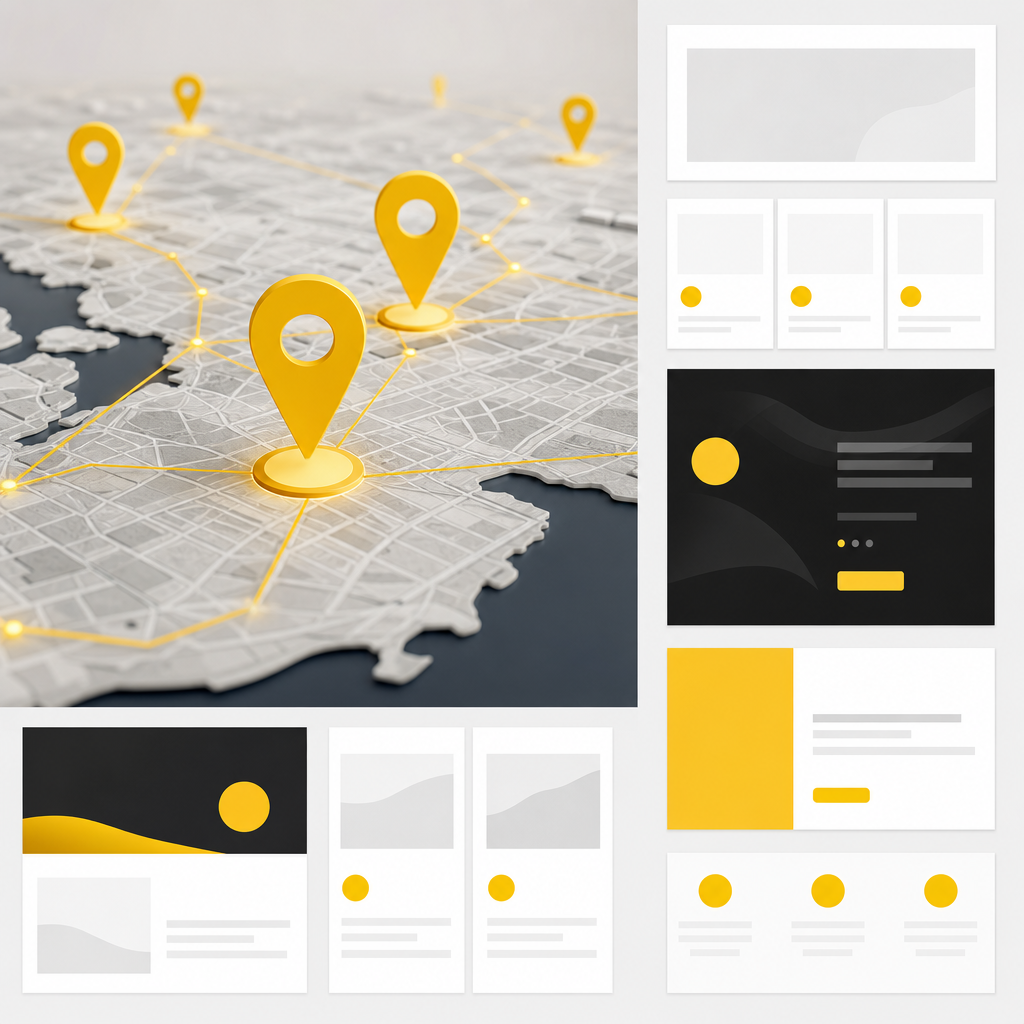
A map-like scene with structured location blocks and connected pathways representing the SEO and conversion blueprint for location pages.

Location pages: the SEO and conversion blueprint

Location pages are your local “landing engines.” A high-performing location page usually includes:

Essential on-page elements

  • NAP (Name, Address, Phone) displayed clearly
  • accurate hours and service coverage (or service areas, when appropriate)
  • embedded maps and easy-to-tap contact CTAs
  • unique copy that matches local intent (not generic marketing text)

Service and relevance blocks

  • services offered at that location
  • industry or use-case targeting (where relevant)
  • location-specific testimonials or proof points
  • FAQs tailored to what customers ask locally

Internal linking that supports discovery

  • links from the location page to the services customers actually search for
  • links from service pages back to relevant locations
  • breadcrumb and navigation patterns that keep users moving

When location pages are designed this way, they become both SEO assets and customer conversion pages.

Centralized management: how franchises keep consistency at scale

Multi-location websites need a management model that supports speed and control. Look for a structure that enables:

  • Templates for page types (home, service, location, landing pages)
  • Role-based editing so teams can update what they own without breaking branding
  • Central content rules for metadata, headings, layout structure, and CTAs
  • Governance for new locations (launch checklists, QA steps, publishing workflows)

If you’re redesigning, confirm your CMS and page templates support centralized control without creating bottlenecks.

Lead routing: turning web traffic into assigned opportunities

A franchise website redesign should map website actions to business outcomes. Common goals:

  • route form submissions to the correct location team
  • assign leads automatically based on territory, location selection, or geography
  • keep attribution clean so reporting is reliable
  • trigger follow-up workflows (email + CRM updates + reminders)

To support this, your website should be integrated with the tools your operations teams already use—through API integrations and automated workflows.

A connected flow of nodes leading to separate territory markers representing automated lead routing for multi-location franchises.

Website speed, mobile UX, and SEO foundations (what matters most)

Your local SEO and conversions depend on technical performance and usability:

  • Mobile responsiveness (most location searches happen on mobile)
  • fast page loads for better user retention and search performance
  • clean information architecture (clear navigation and page hierarchy)
  • SEO-friendly structure (title/heading consistency, internal linking, metadata hygiene)
  • accessibility-friendly layouts (readable, tappable, and easy to navigate)

A redesign should treat these as core requirements, not “nice-to-haves.”

The Website Redesign process for franchise websites

A franchise Website Redesign should be approached like a migration plus an optimization project. A practical process includes:

1) Audit and discovery

  • review current rankings and location page performance
  • identify duplication risks and indexing issues
  • evaluate conversion funnels (where leads drop off)
  • map website pages to franchise operations (who owns what)

2) Information architecture and templates

  • define page templates for each franchise-relevant page type
  • build a scalable location page framework
  • standardize CTA and contact patterns

3) Content plan for locations

  • determine what must be unique vs. centrally managed
  • create location content blocks and SEO-ready sections
  • build internal linking rules

4) Development and integrations

  • implement scalable layouts and CMS templates
  • connect CRMs, automation tools, and any third-party systems
  • add tracking and reporting foundations

5) Migration, redirects, and QA

  • plan URL mapping and redirects
  • prevent broken links and lost SEO signals
  • test across devices and locations

6) Launch and optimization

  • monitor performance per template and per location group
  • refine based on conversion behavior and lead routing outcomes

This approach reduces downtime and helps preserve SEO value while improving user experience.

How to evaluate a franchise web design partner

When choosing a partner for Franchise Website buildouts and redesigns, look for proof of process and franchise-specific capabilities:

  • experience designing multi-location architecture (not one-off pages)
  • centralized templates and brand governance
  • local SEO structure for scalable location pages
  • lead routing and automation integration experience
  • conversion optimization built into design decisions
  • technical execution for performance, security, and maintainability

FAQs

What is a Franchise Website?

A Franchise Website is a scalable website structure designed to support multiple locations under one brand—typically with location pages, consistent branding, local SEO framework, and lead capture/routing for each territory.

How is a Website Redesign different for franchises?

A franchise Website Redesign must manage scale and consistency across many locations. That includes template governance, local SEO structure, URL/migration planning, and integrating lead routing so inquiries reach the right location.

Do you build location pages that support local SEO?

Yes—location pages should follow a repeatable blueprint with unique, location-relevant content blocks, clear contact details, and an SEO-friendly structure designed for multi-location indexing and internal linking.

How do you keep branding consistent across many locations?

By using a centralized design system and location templates with controlled editing rules—so teams can update content without changing layout, design language, or conversion components.

Can the website route leads to the correct franchise location?

A franchise website redesign should connect forms and user actions to the correct CRM/pipeline through automation workflows and integrations—so leads are assigned and followed up properly.

What integrations are typically needed for multi-location websites?

Common integrations include CRMs, email tools, scheduling/appointment systems, tracking/reporting, and other third-party platforms—often via API connections and workflow automation.

Conclusion: Build a Franchise Website that scales

For franchises and multi-location businesses, the best website is a repeatable growth system—not a collection of templates. A strong Website Redesign aligns centralized branding, location-page SEO structure, conversion-focused UX, and lead routing/automation so each location can compete locally while operating under one consistent brand.

CTAs

  • Get a free growth plan for your Franchise Website strategy and redesign roadmap.
  • Explore Website Development to build or modernize a scalable, conversion-focused franchise website with location pages, local SEO structure, and integrations.