
SHAKIR ANSARI
Full Stack & AI Automation Solutions

Full-Stack Development for Custom Booking Platforms

If your business runs on appointments, reservations, rentals, consultations, classes, or scheduled services, a generic website (or “off-the-shelf” booking tool) usually creates more work than it solves.
You need a custom booking system with smart scheduling logic, payments, automated confirmations + reminders, admin dashboards, integrations via APIs, and workflow automation to reduce manual effort.
That’s exactly where Full Stack Development shines—one team building the front-end experience and the back-end systems that power booking, payments, notifications, and reporting.

Book a Discovery Call

Welcome to Shakir Ansari – Full Stack Developer & AI Automation Solutions and the RTP team: custom-coded digital systems that connect your tools, streamline operations, and support long-term growth.

1
Smart scheduling logic

Real-time rules, availability, and operational constraints built for how you work.

2
Payments

Payment workflows, status syncing, and transaction records built to scale.

3
Automated confirmations + reminders

Notification triggers that reduce manual work across confirmations, reminders, and changes.

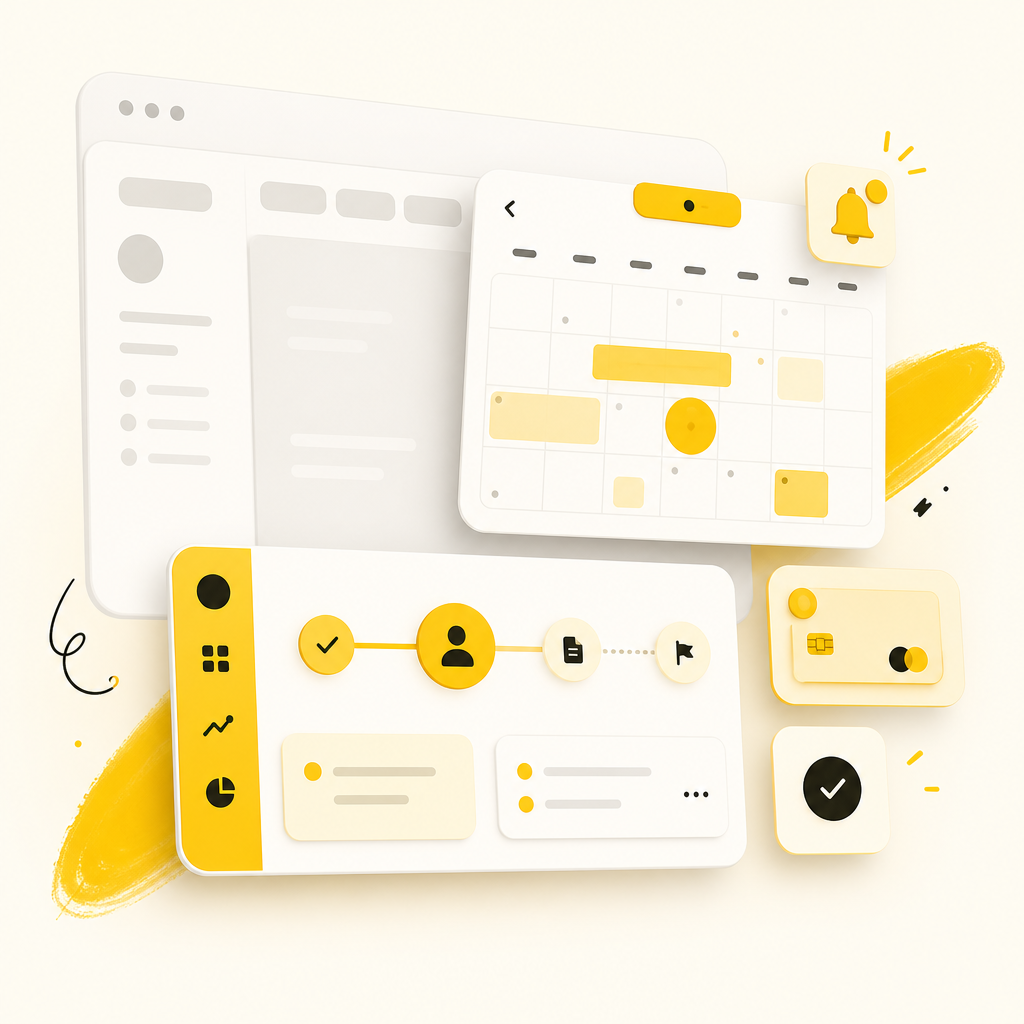
Illustration of a generic booking template replaced by a custom system with scheduling, payments, and notifications.

Why Your Business Needs More Than “Just a Website”

Most businesses start with a template site or basic booking widget. Over time, common problems appear:

  • Customers can’t book the way you actually operate (capacity, rules, lead times, staff availability)
  • Payments are incomplete, inconsistent, or hard to reconcile
  • You manually confirm bookings, send follow-ups, and handle cancellations
  • Your CRM/ERP/email marketing tools don’t sync automatically
  • Reports live in spreadsheets instead of a dashboard
  • Scaling becomes expensive because the “template” architecture can’t evolve

A custom web application replaces manual processes with a system your team can rely on—built around your real workflows.

What Is Full Stack Development?

Full Stack Development means building the complete product—end-to-end:

Front-end (what users see)

  • Booking pages and flows
  • Customer accounts / portals
  • Service listings, calendars, availability views
  • Confirmation screens and booking receipts

Back-end (what runs the business logic)

  • Scheduling rules and availability management
  • Reservation status changes
  • Payment processing workflows
  • Role-based permissions for staff/admins
  • Notification triggers (email/SMS/in-app)

Data layer (your platform’s “source of truth”)

  • Database design and management
  • Booking records, customer data, transaction logs
  • Audit trails and operational history

Integrations layer (connecting your business)

  • APIs that connect to CRMs, ERPs, marketing tools, support systems
  • Webhooks for payment updates
  • Sync for schedules, customer records, and lead status

When it’s done right, full-stack development creates a platform that’s reliable, scalable, automation-ready, and secure.
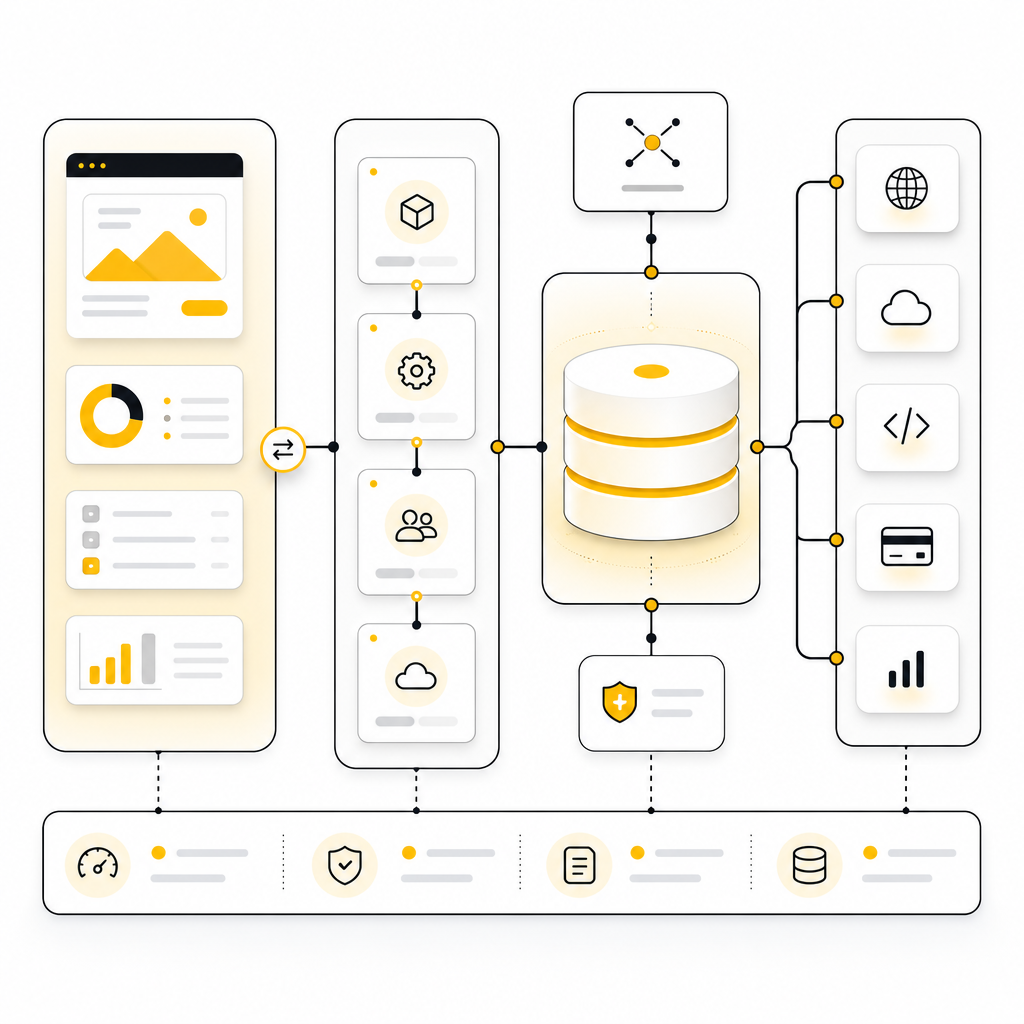
Illustration showing front-end, back-end, data layer, and API integrations working together in full-stack development.

Why Custom Web Development Services Matter for Booking Platforms

A booking platform is more than a calendar. It’s a business system.
That’s why businesses often choose Custom Web Development Services instead of generic templates:

Templates usually fail when you need:
  • Complex availability rules (time blocks, staff capacity, blackout dates)
  • Multiple services with different durations and pricing logic
  • Deposits, partial payments, refunds, and rescheduling rules
  • Multi-location setup
  • Custom admin workflows and internal approvals
  • API-driven integrations and data sync

With custom development, your platform becomes a growth asset—not a patchwork.

The Core Features Your Booking Platform Should Have

If you’re looking for a platform that supports appointments and reservations, here’s what we typically build under full-stack development:

1) Booking, scheduling, and availability engine

  • Real-time availability
  • Reservation status tracking
  • Lead times, buffer times, recurring schedules
  • Rescheduling and cancellation rules
  • Staff/service assignment logic

2) Customer booking experience

  • Mobile-friendly booking flow
  • Clear pricing and service details
  • Notifications at key events
  • Booking history and receipts
  • Customer portal/dashboard

3) Admin panel + operational workflows

  • Manage services, pricing, staff schedules
  • Approve or confirm bookings (if needed)
  • Handle cancellations and refunds
  • Track lead sources and booking conversions
  • Role-based access (admin, staff, manager)

4) Payments and checkout workflows

  • Payment gateway integration
  • Deposits and pay-on-confirm logic
  • Payment status updates and transaction logs
  • Refund workflows and receipts/invoices
  • Optional subscriptions for recurring services

5) Notifications that actually reduce work

  • Confirmation emails/SMS after booking
  • Reminder sequences
  • Cancellation/reschedule notifications
  • Automated follow-ups (post-session, feedback requests)
  • Admin alerts for high-value bookings

6) Reporting dashboards

  • Booking volume, revenue, conversion rates
  • Service and staff performance
  • No-show indicators (where applicable)
  • Exportable reports for finance and operations

This is the difference between “bookings happen” and “bookings run your business efficiently.”
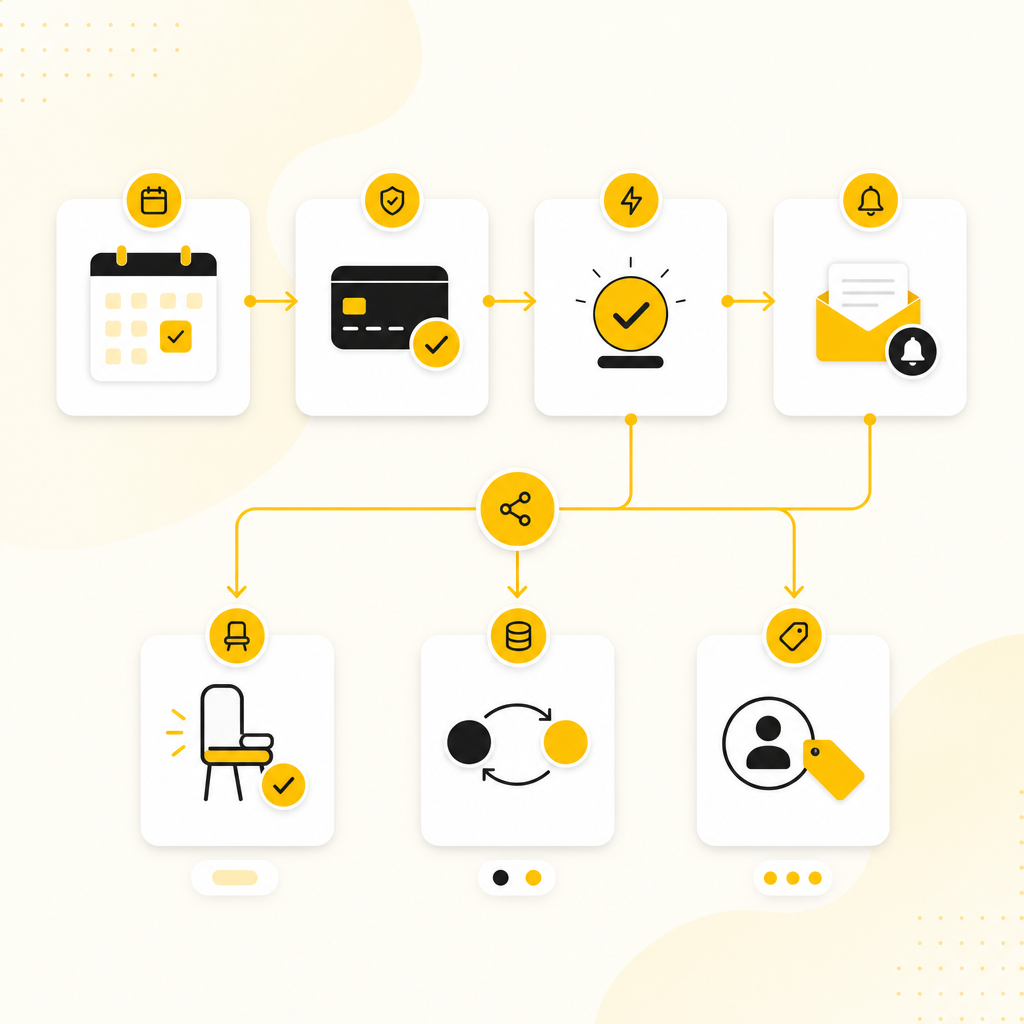
Illustration of automated booking workflows with confirmations, payment updates, and system integrations connected together.

Workflow Automation: The Secret Weapon Behind Modern Booking Systems

Manual follow-ups and spreadsheet tracking don’t scale.
With workflow automation, your platform can automatically handle the operational “busy work” that drains time:

Examples of automation we build
  • When a booking is created → send confirmation + notify staff
  • When payment succeeds → activate the booking + generate invoice
  • If a booking is cancelled → notify customer + free up the slot
  • If a user reschedules → send updated calendar invites and receipts
  • Automatically push booking data to your CRM/ERP
  • Trigger marketing automation (tags, sequences, reactivation campaigns)
Where AI can fit

Once you have strong data + workflows, AI-powered features become realistic, such as:

  • Intelligent appointment recommendations
  • Automated customer support responses
  • Risk detection for no-shows (based on patterns)
  • Proposal drafting or internal summaries (AI-assisted workflows)

Integrations via APIs (So Your Tools Work Together)

A powerful booking platform should connect to the systems you already use.
Using API development and third-party integrations, we can connect your platform to:


  • CRM systems (lead tracking + lifecycle updates)

  • Payment gateways (webhooks for reliable status syncing)

  • Email/SMS marketing tools

  • Google Calendar / Outlook (optional syncing)

  • Accounting tools

  • Support platforms (tickets tied to bookings)

  • Internal tools used by your team

APIs ensure your booking data doesn’t get trapped inside your platform—it becomes usable across your entire business stack.

Website vs Web Application: What You Actually Need

A common business decision is “Do we just need a website?”
Here’s a simple way to choose:

Website
  • Great for marketing content
  • Captures leads
  • Doesn’t manage operational transactions deeply
Web Application (Custom Booking Platform)
  • Manages bookings, payments, rules, status changes
  • Includes dashboards and portals
  • Connects with APIs and automates workflows

If your business depends on scheduling and reservations, you’re not building a brochure site—you’re building a web application.

Real Business Use Cases We Build (Examples)

Below are common systems where full-stack development creates immediate operational value:

Booking Platforms
  • Medical or wellness appointments
  • Legal consultations
  • Training/class scheduling
  • Beauty services + staff-based booking
  • Facility rentals with availability rules
Dashboards and Operations Portals
  • Internal staff calendars
  • Admin reporting
  • Customer portals for history and receipts
CRM/ERP-Linked Booking Systems
  • Lead-to-booking conversion tracking
  • Automated updates to pipelines
  • Finance-ready transaction logs
SaaS-Style Systems
  • Multi-tenant platforms for multiple businesses
  • Subscription plans for access
  • Role-based admin management

With SaaS development and multi-portal architecture, your platform can evolve beyond one business into a scalable product model.

Security, Performance, and Scalability (Non-Negotiable)

Security improvements

  • Authentication and role-based permissions
  • Secure payment workflows
  • Data protection best practices
  • Audit trails for booking and payment status

Performance optimization

  • Fast booking availability checks
  • Scalable database queries
  • Clean UI flows that reduce drop-off

Scalability

  • Support increasing booking volume
  • Handle more locations/services/staff
  • Extend features without rebuilding from scratch

When businesses grow, the platform must grow with them.

How We Help: End-to-End Full Stack Development Process

Our approach is designed to reduce risk and ensure you get a platform that works for your team from day one.

1
Discovery & Requirements

  • Understand booking workflows and edge cases
  • Map user roles (customer, staff, admin)
  • Identify integrations and automation needs
2
UX + Booking Flow Design

  • Booking journeys that convert
  • Clear forms and service selections
  • Admin and customer portal UX
3
Architecture + Data Modeling

  • Scheduling logic design
  • Database schema planning
  • API strategy and integration mapping
4
Full Stack Development

  • Front-end build (modern UI)
  • Back-end build (business logic + services)
  • Admin panel + user portal
  • Payments + webhook integration
  • Notifications + workflow automation
5
QA, Testing, and Hardening

  • Booking rule testing
  • Payment status edge cases
  • Security and usability checks
6
Launch + Maintenance + Upgrades

  • Monitoring and issue resolution
  • Feature expansion as you scale
  • Continuous improvements

With 10+ years of experience and 1300+ web applications developed, Shakir Ansari and the RTP team build reliable systems that stand up to real business operations.

Tech Stack (What We Commonly Use)

Full-stack delivery can be adapted to your needs, but typical capabilities include:

  • React for front-end experiences
  • PHP/Laravel for scalable back-end systems
  • Node.js for services and integrations
  • Database design with robust, production-ready models
  • API integrations for connecting third-party tools
  • Optional mobile extensions (e.g., React Native) for booking access on the go
  • WordPress/Shopify/WooCommerce integrations when needed

How Much Does Custom Booking Platform Development Cost?

Cost depends on scope, complexity, and integrations. Projects are usually impacted by:

  • Number of booking flows (services, staff, locations)
  • Complexity of scheduling rules (capacity, buffers, lead times)
  • Payment model (deposits, refunds, recurring, invoicing)
  • Required portals (admin, staff, customer)
  • Notification channels (email/SMS/in-app)
  • Integrations (CRM, marketing tools, accounting, calendars)
  • Custom design vs template-based UI
  • AI features (optional—usually added after core platform is stable)

Budget mindset (typical)

Most businesses plan for a range from a few thousand to tens of thousands depending on complexity, with many scaling into larger builds when payments + integrations + automation are included.

If you want, share your services and booking rules—we can help estimate scope and propose a phased plan to control cost while still launching something valuable quickly.

Build Custom or Use Off-the-Shelf? (The Business Case)

Choose custom development when you need:

Choose custom development when you need:
  • Your booking flow to match your real operations
  • Payments and notifications to behave exactly as required
  • Integrations to reduce manual re-entry
  • Admin tools your team will actually use
  • A platform that scales without rewriting everything
Choose off-the-shelf when:
  • Your booking requirements are simple
  • You can adapt your business process to the tool
  • Integration requirements are minimal

For most appointment-heavy businesses, custom full-stack development is the long-term efficiency win.

Checklist: How to Choose the Right Full Stack Development Partner

When evaluating providers for Custom Web Development Services and Full Stack Development, ask:

  • Can you build complex scheduling logic and rule-based availability?
  • Do you handle payments + webhooks reliably?
  • Will you create admin dashboards and customer portals?
  • How do you approach workflow automation and notifications?
  • Can you integrate with CRMs/marketing/payment tools via APIs?
  • What’s your QA/testing process for edge cases?
  • Do you offer ongoing maintenance and feature upgrades?

Shakir Ansari and the RTP team are built for businesses that need dependable systems—not just “a site that looks good.”

Frequently Asked Questions


1) What’s the difference between a custom website and a booking web application?

A website is primarily for marketing and lead capture. A booking application manages scheduling, availability, payment workflows, notifications, and admin operations.


2) Can full-stack development include payments and notifications?

Yes. We typically implement payment gateway integrations, webhook-driven status updates, and automated notifications for confirmations, reminders, and cancellations.


3) Do you build admin panels and staff portals too?

Absolutely. Booking platforms usually need role-based admin and staff dashboards for managing bookings, schedules, and operational workflows.


4) Can we integrate our CRM and marketing tools?

Yes. With API development and third-party integrations, we connect your booking platform to CRMs, email/SMS tools, and other business systems.


5) How does workflow automation reduce costs?

By removing repetitive manual tasks—like sending updates, updating records, notifying staff, and syncing data—automation improves speed and consistency.


6) Can the platform be expanded later into a SaaS model?

If your product strategy requires it, we can design the architecture for scalability, multi-tenant support, and SaaS-style growth.


7) Do you also handle security and performance?

Yes. We prioritize security, optimize booking queries and page performance, and design for scaling as booking volume grows.


8) Can AI be added to a booking platform?

AI is typically best added after the platform’s core data and workflows are stable—then AI can automate support, recommendations, and internal reporting.

Ready to Build Your Custom Booking Platform?

If you’re outgrowing templates and want a custom full-stack booking system—with payments, notifications, dashboards, integrations, and workflow automation—Shakir Ansari and the RTP team can help you plan and build the right platform.

Get a project discovery call and we’ll recommend the best approach for:

  • Your booking flows
  • Your payment model
  • Your automation + integration needs
  • A phased plan that gets you live faster


Start Your Project

Let’s build a smarter digital system that saves time and supports growth.