
SHAKIR ANSARIFull Stack Developer & AI Automation Solutions

Full-Stack ERP Integration & API Development

If your business runs on an ERP but your website, portal, or internal tools don’t “talk” to it yet—your teams are stuck with manual updates, delayed inventory, and reporting gaps.

Shakir Ansari – Full Stack Developer & AI Automation Solutions builds custom full-stack systems that connect your web applications directly to your ERP for inventory, finance, order management, procurement, HR, and internal operations—with secure APIs, reliable data sync, and performance-first architecture.

Custom full-stack development for businesses that need reliable, scalable, and automation-ready web applications.

Request an ERP Integration Consultation

secure APIs

secure APIs

reliable data sync

reliable data sync

performance-first architecture

performance-first architecture

Why Your Business Needs More Than a Website

A website can sell.

A web application connected to your ERP can run your operations.

When your front-end experience (customers, staff, admins) is disconnected from your back-office systems, you get:

  • Double entry of inventory, orders, and customer data
  • Stock-outs caused by slow or inaccurate updates
  • Manual reconciliation between e-commerce and ERP
  • Reporting that takes days instead of hours
  • Processes that break during growth

A full-stack approach solves this by building a single, integrated system—from UI to API to databases to analytics—so your tools stay synchronized as your business scales.

One team owns the entire system, so changes don’t create integration chaos.

A website can sell. A web application connected to your ERP can run your operations.
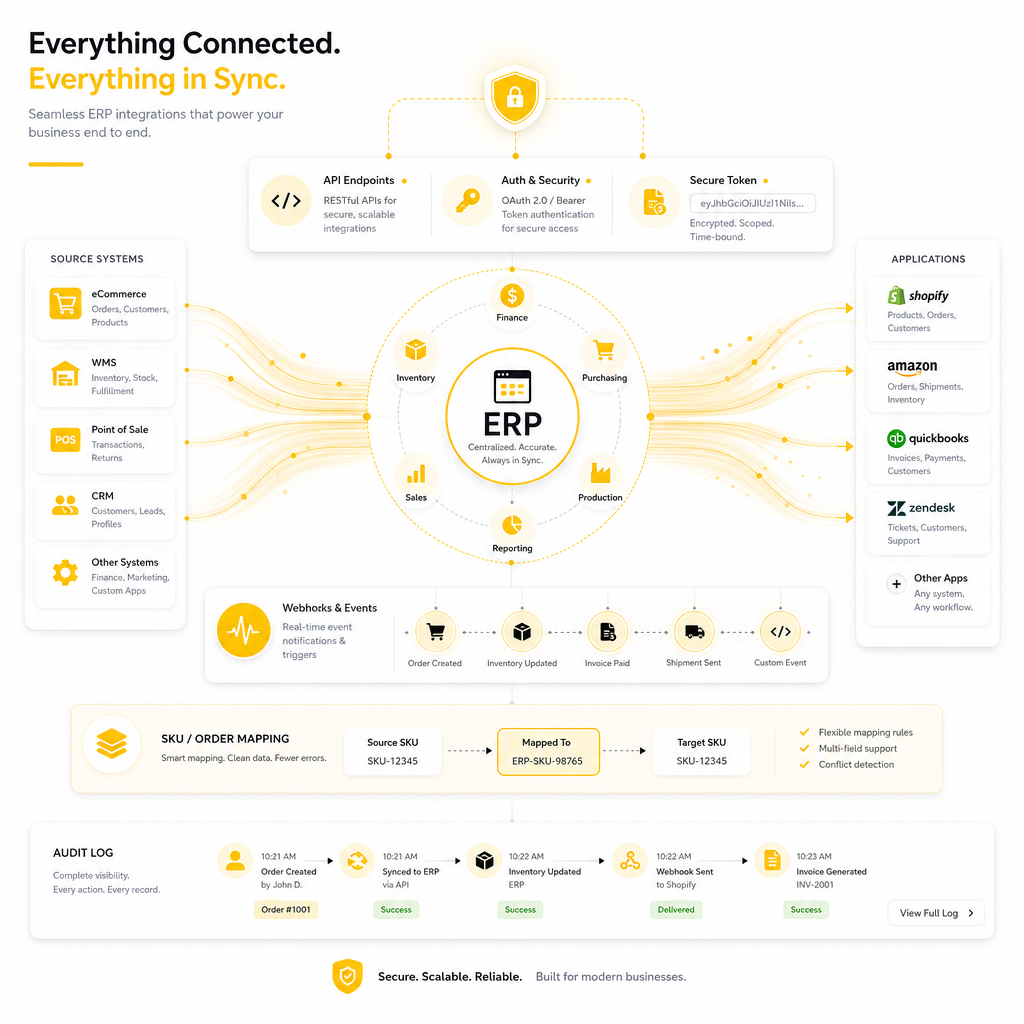
Connected data flows

Illustration of secure ERP integration components with API connections, webhooks, and audit log flow.

APIs, webhooks, and synchronization

Audit logs and traceability

ERP Integration: What It Actually Involves

ERP Integration isn’t just “sharing data.” It’s building a reliable connection between systems so business events flow accurately and on time.

Typical integration components include:

  • API integration between your ERP and web apps
  • Data synchronization (one-way or two-way)
  • Authentication & access control (secure tokens, roles, permissions)
  • Webhooks / event triggers (real-time updates when events happen)
  • Order/inventory mapping (SKUs, warehouses, currencies, tax rules)
  • Error handling & retry logic (so failures don’t break operations)
  • Audit logs for traceability and compliance
  • Analytics layer for decision-making dashboards

That’s where custom full-stack development—and custom API development services—becomes essential.

Who This Pillar Page Is For

This page is for businesses needing ERP integrations—organizations that need web applications connected with ERP systems for:

  • Inventory management
  • Finance and invoicing
  • Order management
  • Procurement workflows
  • HR and internal operations
  • Other ERP-driven business processes

If you’re outgrowing templates and “bolt-on” tools, you’re in the right place.

Why Full-Stack Development Works Best for ERP Projects

Many businesses start with a “front-end build” or a “software integration” and end up with fragile results.

A full-stack team delivers better outcomes because the integration is designed end-to-end:
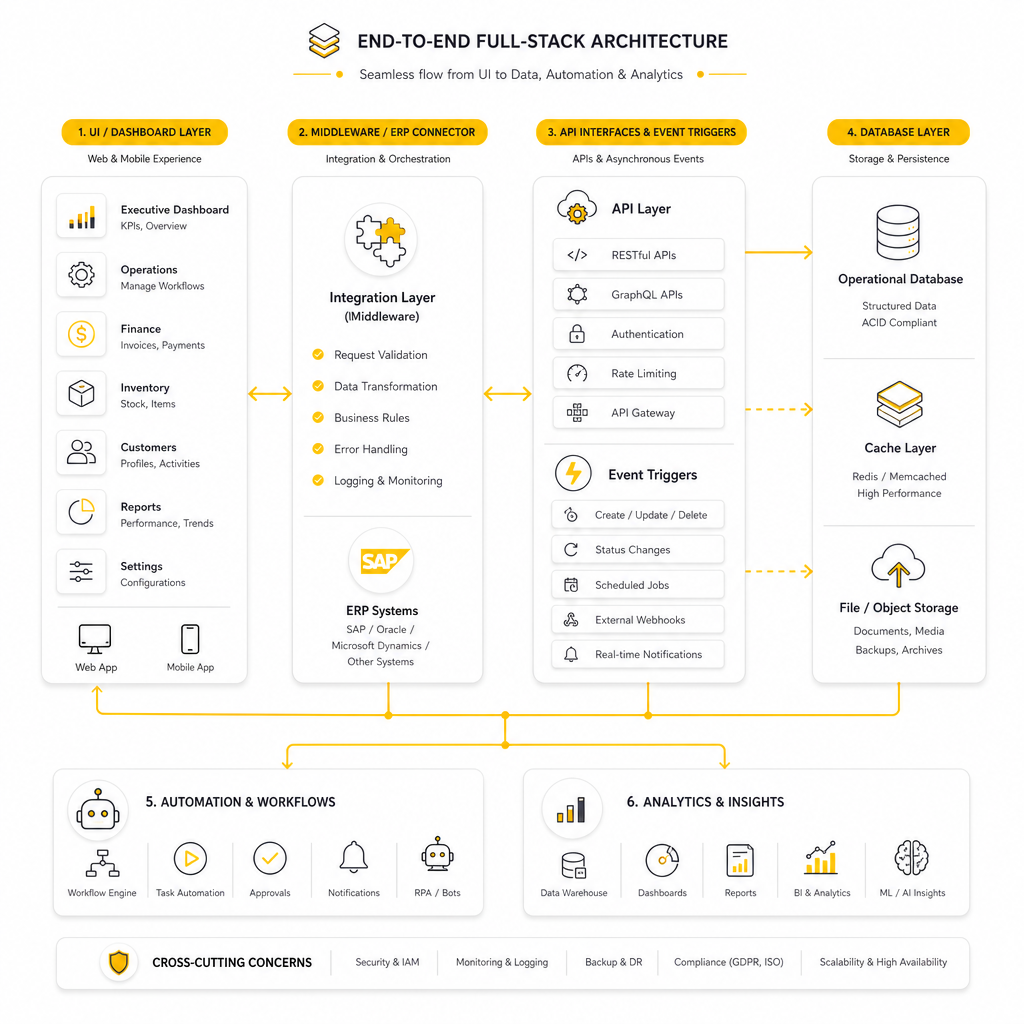
  • Front-end: admin panels, user portals, dashboards, e-commerce UI
  • Back-end: business logic, ERP connector services, middleware
  • APIs: consistent interfaces between your systems and the ERP
  • Databases: mapping, normalization, and data integrity
  • Automation: workflows that reduce manual tasks
  • Security & performance: scalable architecture that won’t slow down at scale
  • One team owns the entire system, so changes don’t create integration chaos.
End-to-end system layers

Illustration of an end-to-end full-stack ERP architecture with UI, APIs, databases, and automation layers.

What We Build: Full-Stack ERP-Ready Digital Systems

When you choose Shakir Ansari and the RTP team, you get an implementation that supports growth, not just launch.

1) Custom ERP-Integrated Web Applications

  • Admin panels and internal portals
  • Role-based access for teams and locations
  • Operational workflows connected to ERP processes

2) ERP-Connected E-commerce Experiences

  • Product, pricing, and stock synchronization
  • Order creation & fulfillment updates to ERP
  • Returns and refunds aligned with ERP records
  • Payment workflow handoff that supports accurate order status

3) Dashboards & Analytics Services

Operational visibility is critical. We build analytics that answer:

  • What’s selling and what’s not?
  • Which SKUs are at risk of stock-outs?
  • How are orders moving through fulfillment?
  • Where do delays or errors occur?

Analytics Services may include:

  • Inventory health dashboards
  • Sales and order performance reporting
  • Procurement and purchasing insights
  • Finance-ready reporting views
  • KPI dashboards for managers and operators

4) API Development & Third-Party Integrations

APIs are the backbone of modern systems. We design and build:

  • REST or GraphQL APIs
  • ERP integration endpoints and connector services
  • Middleware for data transformation and routing
  • Integration with CRMs, payment gateways, marketing tools, and internal automation

This includes Custom API Development Services tailored to your ERP and business rules.

5) Automation-Ready Platforms (Including AI Support)

We also help businesses move beyond manual steps using:

  • Workflow automation for approvals, updates, and status changes
  • AI-powered assistance where it adds value (e.g., operational insights, automation agents, smarter data handling)
  • Scalable architecture that keeps automation reliable

Key Benefits You Get From an ERP-Integrated Full-Stack Build

1

Save Time by Removing Manual Work

Your teams stop copying data between tools.

2

Improve Accuracy Across Inventory, Orders, and Finance

Real-time or scheduled sync reduces mismatches.

3

Make Better Decisions Faster With Dashboards

Instead of waiting for reports, you get actionable insights.

4

Scale Without Rebuilding

A structured API + scalable back-end prevents future integration rewrites.

5

Strengthen Security and Reliability

We implement role-based access, secure auth patterns, and operational logging.

Common ERP Integration Use Cases

Here are real scenarios businesses typically need solved:
Inventory & Warehouse Synchronization

  • Sync stock levels by warehouse/location
  • Update availability on sales or returns
  • Prevent customer overselling and internal stock confusion

Order Management Workflows

  • Automatically push orders from web/e-commerce to ERP
  • Update order status in the ERP back to your portal/website
  • Coordinate fulfillment events and delivery statuses

Procurement and Purchasing Automation

  • Trigger purchase workflows based on re-order thresholds
  • Route approvals and track purchasing steps
  • Keep ERP purchasing records aligned with internal requests

Finance, Invoicing, and Billing Alignment

  • Ensure invoice data matches order data
  • Synchronize payments and reconcile statuses
  • Maintain consistent reporting across teams

HR and Internal Operations

  • Integrate employee-related data flows when needed
  • Keep internal tools consistent with ERP records
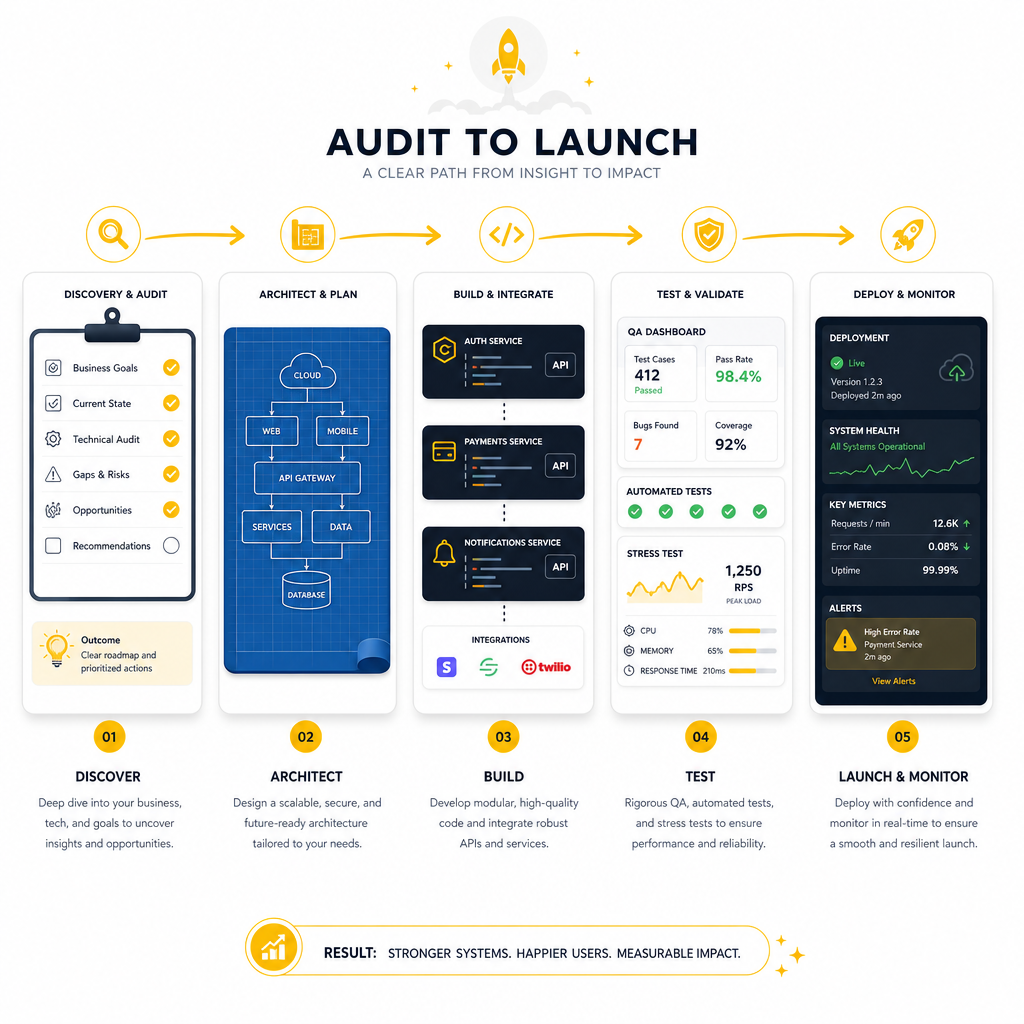
Audit to launch process

Illustration of the ERP integration process from discovery and API design through QA and deployment monitoring.

Our Full-Stack ERP Integration Process (From Audit to Launch)

Step 1: ERP Integration Discovery & Mapping

  • Identify ERP modules used (inventory, finance, procurement, etc.)
  • Map data fields and business rules
  • Define event flow (what triggers updates, when, and how)

Step 2: System Architecture & API Design

  • Choose integration patterns (APIs, webhooks, sync scheduling)
  • Build a robust data model and transformation rules
  • Plan security: authentication, permissions, and audit logs

Step 3: Development (Front-End + Back-End + APIs)

  • Build dashboards, portals, and UI experiences
  • Implement ERP connector services and integration APIs
  • Set up integration testing with realistic scenarios

Step 4: QA, Performance, and Reliability Testing

  • Validate data correctness under edge cases
  • Stress test key workflows (orders, inventory updates)
  • Confirm graceful error handling and retries

Step 5: Deployment, Monitoring, and Optimization

  • Launch with monitoring and operational alerts
  • Improve performance and fix integration edge cases
  • Add features and iterate as your business grows

Talk to Our Team About Your ERP Integration

Technology & Platform Compatibility (What We Typically Work With)

We build with modern stacks suited for scalable business systems, including:

  • Front-end: React and modern web UI patterns
  • Back-end: PHP/Laravel, Node.js, and similar service architectures
  • Database design & management for integration-ready data models
  • API development for ERP connectors and third-party integrations
  • E-commerce support (Shopify/WooCommerce/WooCommerce-style workflows where relevant)
  • Security-first implementation and performance optimization

If you already have an ERP and a web app—or you’re planning both—we can integrate into your existing ecosystem.

Why Choose Shakir Ansari & the RTP Team

Experience and full-stack delivery

  • 10+ years of experience
  • 1300+ web applications developed
  • Full-stack delivery: front-end to back-end to API to automation

Expertise built for reliability

  • Expertise across: Laravel, PHP, React, WordPress, Shopify, WooCommerce, and scalable API integrations
  • Focus on reliable workflows, security improvements, performance optimization, and future feature upgrades

You need more than “integration code.” You need a team that builds systems businesses can rely on.

Frequently Asked Questions

What ERP systems do you integrate with?

We integrate based on your ERP’s available interfaces (APIs, exports/imports, webhooks, or supported data mechanisms). During discovery, we map the best approach for your exact ERP and workflow needs.

How long does an ERP integration project take?

Timeline depends on complexity: number of modules, data mappings, sync frequency, UI/dashboard requirements, and third-party systems. After a discovery and mapping session, we provide a practical plan and milestones.

Do you build both the website/app and the ERP connection?

Yes. Our full-stack approach covers the web application, APIs, data logic, dashboards, and the ERP integration—so the system works as one connected product.

Can you handle real-time inventory and order updates?

Yes. We design integrations using event-driven patterns (APIs/webhooks) or scheduled synchronization where appropriate—based on your operational requirements and ERP capabilities.

Do you also provide ongoing support and improvements?

Yes. We support monitoring, maintenance, security upgrades, and feature enhancements so your integration stays stable as your business changes.

Ready to connect your web apps to your ERP so inventory, orders, finance, and operations sync automatically?

Get a tailored ERP integration plan built with full-stack development—secure APIs, dashboards, automation-ready workflows, and analytics that help you run smarter.

Request an ERP Integration AuditGet a Quote for Custom API Development Services