
SHAKIR ANSARI Full Stack Developer & AI Automation Solutions

Nonprofit Website Development: Custom Online Forms, Payroll Giving, and SEO

A nonprofit website should do more than “look good.” It should support your mission every day—by making it easy to donate, register for events, and apply to volunteer—while also earning visibility through SEO for nonprofits and building public trust with fast, secure, accessible design.

Explore Website Development

Custom Online Forms

for donations, registrations, and volunteer interest

Payroll Giving

experiences that guide donors

SEO for Nonprofits

helps supporters find your work

What Your Nonprofit Website Must Achieve

Nonprofit organizations typically need a website that supports multiple journeys at once:

Donors

one-time giving, recurring giving, and simple confirmation flows

Volunteer prospects

clear impact messaging and an easy way to apply

Community members

event pages with registration, reminders, and updates

Trust building

transparent programs, outcomes, policies, and credibility signals

Operational efficiency

automated follow-ups, CRM updates, and reporting

To meet all of these goals, your site needs more than templates—it needs custom functionality, clean information architecture, and reliable integrations.
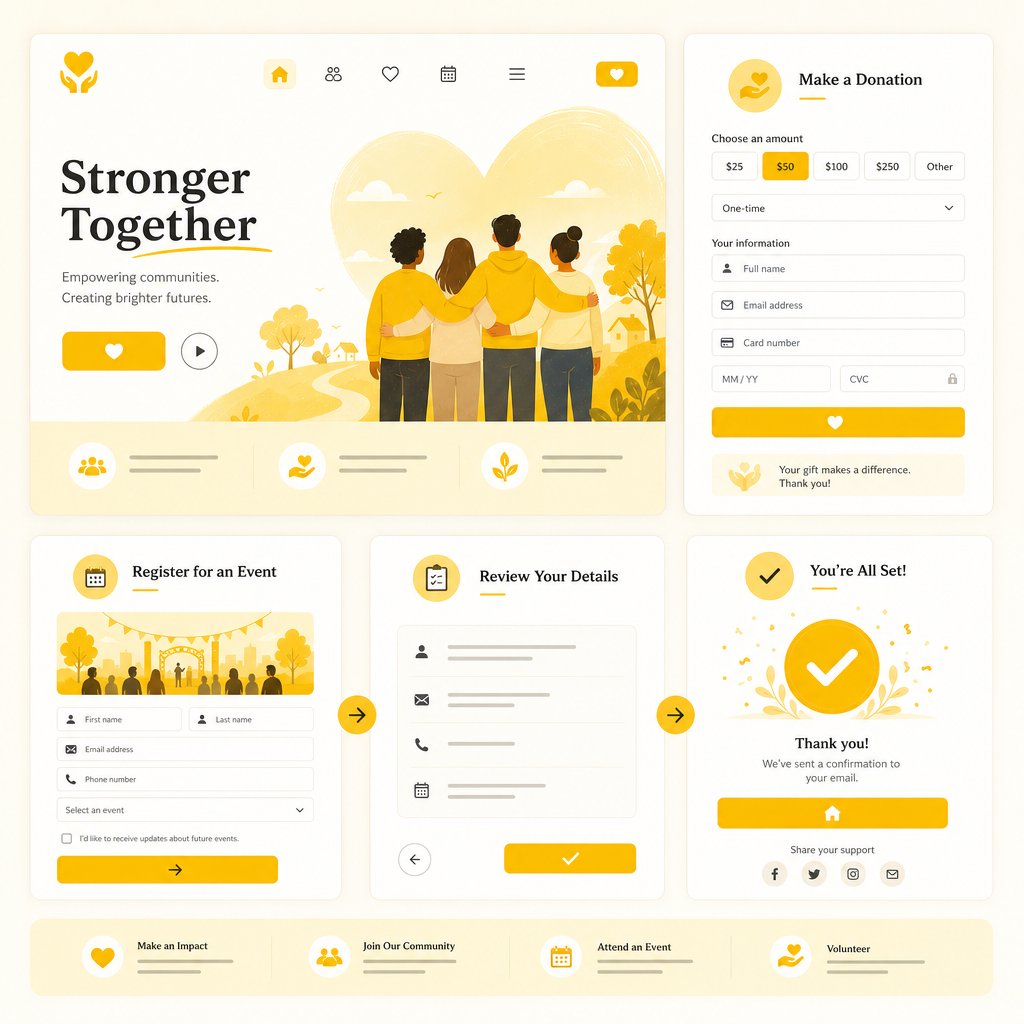
Illustration of a nonprofit website donation and registration form flow showing organized fields and confirmation.

Custom Online Forms for Donations, Events, and Volunteers

Generic forms often break the experience: too many fields, confusing steps, missing confirmations, poor mobile usability, or no automation behind the scenes. Custom Online Forms make your website more effective by matching how people actually give, sign up, and engage.

This guide explains how professional nonprofit website development turns your site into a growth-focused platform using:

  • Custom Online Forms for donations, registrations, and volunteer interest
  • Payroll Giving experiences that guide donors and simplify submissions
  • seo services for nonprofits that helps supporters find your work in search engines

1) Donation Forms That Convert (and Reduce Support Requests)

A well-built donation form helps supporters complete giving confidently. Common features include:

  • Donation type selection: one-time vs. recurring
  • Suggested amounts with custom entry
  • Simple personal details with clear labels
  • Accessible error handling (no confusing validation)
  • Confirmation screens and/or email receipts
  • Trust cues (secure payment messaging near the action)

A custom build also makes it easier to connect your donation flow to the tools you already use—like your donor database, email platform, and internal reporting.

2) Event Registration Forms That Stay Organized

Event pages generate signups—but without strong forms and automation, you lose momentum after people submit. Your event registration forms should support:

  • Registration fields tailored to your event type
  • Confirmation messaging and reminders
  • Tagging/segmentation for follow-up communications
  • Data routing to your CRM or event management system
  • Optional add-ons (e.g., check-in info, dietary notes) without overwhelming users

3) Volunteer Application Forms That Capture the Right Details

Volunteer interest forms should balance thoroughness with usability:

  • Questions that map to roles, availability, and location
  • Clear next steps after submission
  • Internal notifications so applications don’t get lost
  • Automated acknowledgments and follow-up sequences

4) Form Design Best Practices for Nonprofits

Custom doesn’t just mean “different”—it means more effective. For nonprofits, form best practices include:

  • Mobile-first layouts (most submissions happen on phones)
  • Accessibility (keyboard-friendly navigation, readable contrast, proper labels)
  • Fast loading and minimal friction
  • Privacy and consent messaging where needed
  • Analytics and tracking to see where people drop off

5) Automation Integrations Behind the Forms

Forms become a true business asset when submissions automatically trigger workflows such as:

  • Sending confirmation emails and next-step instructions
  • Updating a CRM record
  • Tagging donors/volunteers by campaign, event, or interest
  • Creating tasks for staff follow-up
  • Logging activity for reporting and impact metrics

This is where professional custom web development sevices provides long-term value: your forms don’t just collect information—they power your operations.

Payroll Giving: A Website Experience Built for Ongoing Support

Payroll giving is one of the most powerful ways nonprofits can build stable long-term funding. Your website plays a major role in educating supporters and helping them take action.

A strong payroll giving experience on your website typically includes:

1) Clear Education That Matches Donor Intent

Supporters often arrive with questions like:

  • What is payroll giving?
  • How do I set it up through my employer?
  • What impact does it have for your programs?

Your site should present payroll giving information in an easy-to-scan structure, supported by a straightforward next-step CTA.

2) Guided Flows and Submission-Ready Online Forms

Instead of redirecting people into disconnected processes, your payroll giving flow can include:

  • Dedicated payroll giving landing pages
  • Custom online forms to capture key details
  • Employer-related fields (where applicable to your process)
  • Confirmation and tracking that staff can act on quickly

3) Automation for Follow-Up and Reporting

Payroll giving typically requires ongoing engagement. Your workflows can automate:

  • Confirmation and intake for payroll giving inquiries
  • Internal notifications for follow-up
  • Updates to donor records and communication preferences
  • Reporting-friendly data organization

When payroll giving is supported by the right web workflows, staff spend less time chasing information—and donors experience a smoother path to commitment.
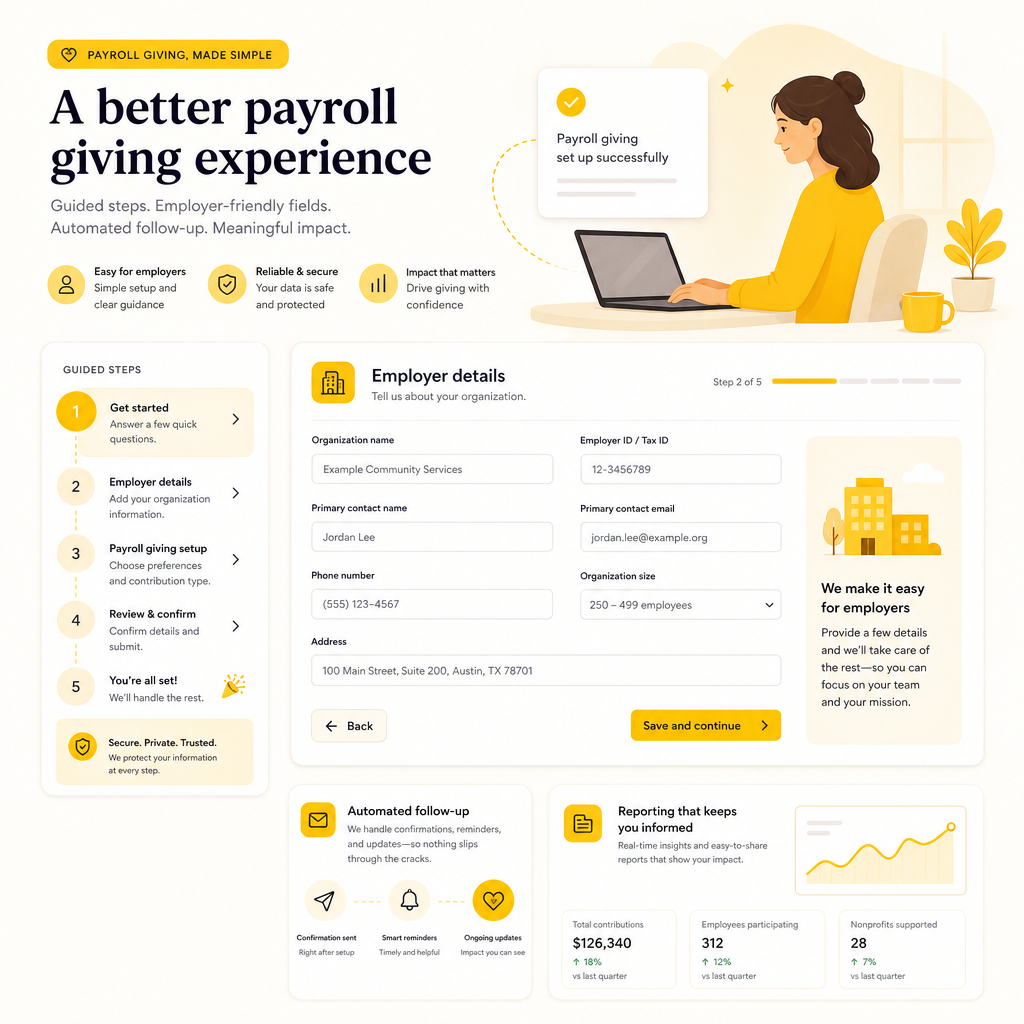
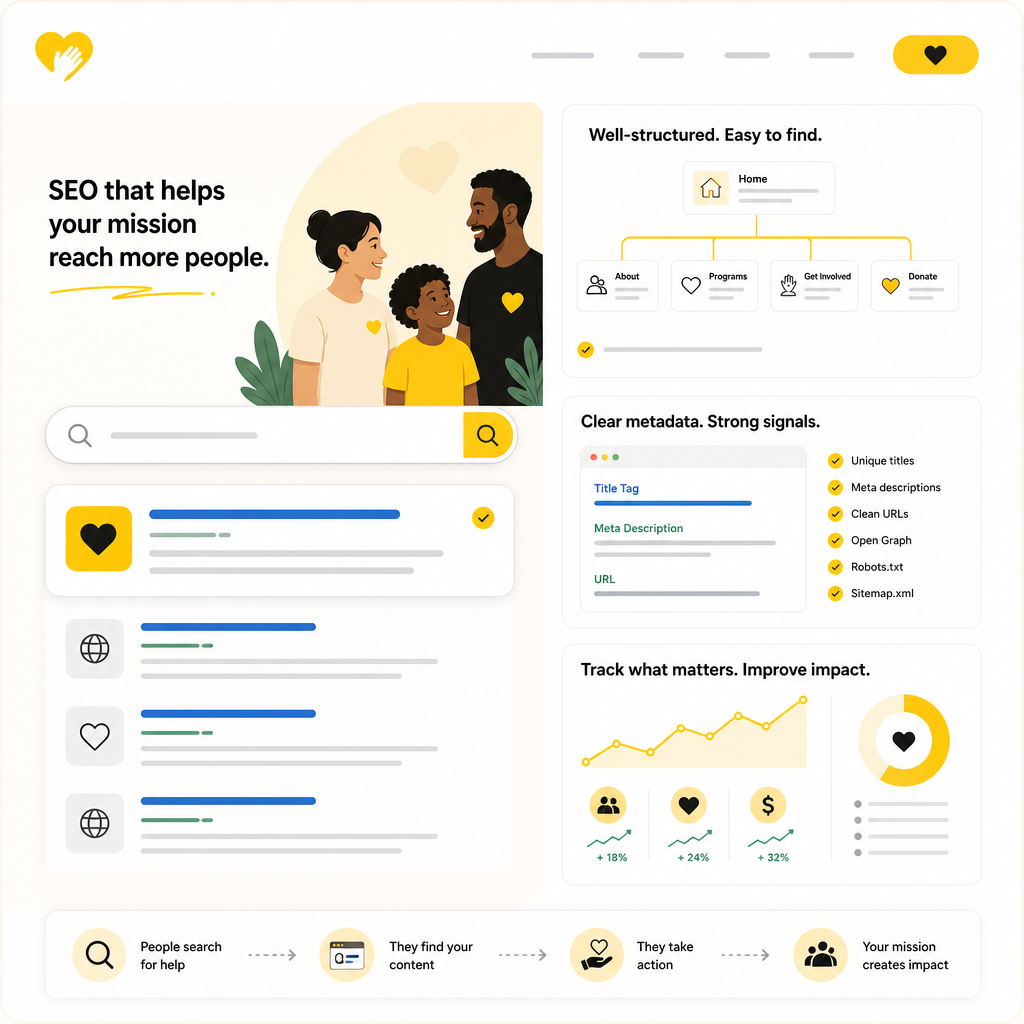
Illustration of a payroll giving setup experience with guided steps and confirmation-ready flow.

Illustration of SEO-friendly nonprofit website structure with search visibility and conversion tracking cues.

SEO for Nonprofits: Helping Supporters Find You (and Convert)

Even the best website underperforms without discovery. SEO for nonprofits helps your organization show up when people search for causes, volunteering opportunities, events, and giving options.

1) Start with Nonprofit Search Intent

Nonprofit SEO should align content with what users actually want, such as:

  • “How to donate to [cause/area]”
  • “Volunteer opportunities near me”
  • “Upcoming events for [cause]”
  • “Nonprofit programs in [city/region]”
  • “Payroll giving [organization type]”

Your site’s pages should reflect these journeys, not just your internal priorities.

2) Build the Right Nonprofit Page Structure

Common SEO-friendly site components include:

  • Program and impact pages (with supporting details)
  • Events pages with real dates and structured content
  • Volunteer pages with role clarity and application paths
  • Clear donation pathways (including recurring/ongoing giving info)
  • Dedicated location pages if you serve multiple regions

3) Technical SEO That Supports Speed, Trust, and Rankings

High-performing nonprofit websites typically include:

  • Fast load times and optimized assets
  • Mobile responsiveness across devices
  • Clean URL structure and logical internal linking
  • Indexable pages with proper metadata
  • Structured data for better search understanding (e.g., Organization/Event)

4) Track Conversions, Not Just Traffic

Traffic is useful, but nonprofit success depends on outcomes. Pair SEO with conversion tracking so you can measure:

  • Donation clicks and completed donations
  • Volunteer application form starts and submissions
  • Event registration conversions
  • Payroll giving page engagement and form submissions

A site built with conversion analytics becomes easier to improve over time—campaign by campaign.

Why Custom-Built Nonprofit Websites Beat Templates

Templates can be a starting point, but they often fall short for nonprofits because:

  • Your forms and workflows are unique (and you need integrations)
  • Your content and program structure doesn’t always fit a generic layout
  • You may need custom pages for fundraising and operational processes
  • Performance and accessibility requirements vary by organization
  • Scaling and updating template systems can become restrictive later

custom-coded development, your website can be built to support your mission now—and evolve as your programs grow.

A Practical Development Approach for Nonprofits

  1. Discovery & goals: map user journeys (donate, volunteer, event, learn)
  2. Information architecture: create a navigation structure that supports intent
  3. Custom form planning: define fields, confirmation steps, and automation triggers
  4. Design with trust in mind: credibility, accessibility, and clear CTAs
  5. Development & integration: connect donation tools, email systems, CRM, and automation
  6. SEO foundations: technical setup, on-page structure, and scalable content templates
  7. Quality assurance: test across devices, accessibility checks, and conversion testing
  8. Launch & improvements: monitor performance, refine forms, and improve conversion paths

Common Nonprofit Website Issues (and What to Fix)

  • Donation forms are hard to use on mobile → rebuild for mobile-first conversion
  • Event pages don’t lead to registrations smoothly → simplify flows and automate follow-up
  • Volunteer applications lack clarity → refine questions and post-submit next steps
  • No tracking of conversions → implement analytics for donation/volunteer/event outcomes
  • SEO is treated as an afterthought → design structure and pages for search intent from day one
  • Templates limit customization → invest in custom online forms and integrations that match your operations

Frequently Asked Questions

1) What makes nonprofit website development different from a regular business site?

Nonprofit sites must support mission storytelling and trust, but they also need high-converting journeys for giving, volunteering, and event registration—often with custom forms, automation workflows, and stronger conversion tracking.

2) Are custom online forms necessary for donations and events?

They’re often the difference between a website that “collects submissions” and one that reliably converts. Custom online forms improve usability, reduce errors, and enable automation integrations for follow-up and reporting.

3) How does SEO help nonprofits beyond getting more traffic?

SEO for nonprofits improves visibility for high-intent supporters searching for ways to donate, volunteer, and attend events. When combined with conversion tracking, it also increases real outcomes, not just visits.

4) What should a payroll giving page include?

A strong payroll giving experience explains the concept clearly, answers common questions, and provides an easy next step—often supported by a dedicated page and a form or guided submission flow.

5) What integrations are commonly connected to nonprofit website forms?

Common integrations include email and marketing tools, donor/volunteer databases (CRMs), internal notification systems, and payment and ticketing workflows.

6) Can a nonprofit site be built for accessibility and performance?

Yes. A professional development process should include accessibility best practices (readable, navigable experiences) and performance optimization so pages load quickly and work well on mobile devices.

Conclusion: Turn Your Nonprofit Website into a Trust + Conversion Asset

A great nonprofit website is a mission platform—not an online brochure. With custom online forms, a thoughtful payroll giving experience, and SEO for nonprofits built around supporter intent, your site can improve fundraising, volunteer engagement, event participation, and public trust.

If you’re ready to modernize your site with custom functionality and scalable growth support, explore how Shakir Ansari – Full Stack Developer & ai automation services Solutions and the RTP team approach nonprofit website development—built for speed, conversions, and long-term operational efficiency.

Explore Website Development

Explore Website Development to build (or improve) a nonprofit website with custom online forms, payroll giving experiences, and SEO-ready structure that supports donations, volunteers, and events.

Explore Website Development