
SHAKIR ANSARI

SEO Services for Manufacturers & Industrial Growth

Manufacturing and industrial companies don’t just compete for traffic—they compete for qualified B2B demand. Buyers search for products, specifications, capabilities, certifications, and suppliers, often with complex purchasing requirements and long evaluation cycles. That’s why SEO for manufacturers needs more than generic blog posts. It needs technical strength, capability-focused content, and a website foundation built to convert procurement-intent visitors into leads.

At Shakir Ansari – Full Stack Developer & AI Automation Solutions (RTP team), the focus is on practical, growth-driven SEO—supported by Web Design & Development and reinforced with Automation Solutions that help track, improve, and scale your search performance over time.

Why SEO Matters More for Manufacturers Than “More Traffic”

For manufacturers, the goal isn’t just ranking—it’s winning the right opportunities:

  • Procurement-driven search intent: People search for services like yours by capability and requirements (materials, tolerances, certifications, industries served).
  • Sales cycles are longer: Strong SEO compounds credibility and visibility across months of research.
  • Trust is built through relevance: Well-structured capability pages and product/spec content help buyers validate fit faster.
  • Organic visibility reduces dependency on paid ads: SEO becomes a durable channel that continues generating demand.

When SEO is implemented correctly, your website starts acting like a sales asset—turning “researchers” into “qualified leads” who already know what they’re looking for.

What “SEO for Manufacturers” Really Includes

A manufacturing SEO program typically covers three layers that must work together:

  1. Technical SEO (can search engines crawl, interpret, and trust your site?)
  2. Content & on-page SEO (does your site match what buyers search for?)
  3. Authority, UX, and conversion (does your site earn trust and capture leads?)

Below is what that looks like in a real-world industrial SEO strategy.

1) Technical SEO Built for Industrial Websites

Industrial websites often start as complex platforms—multiple templates, CMS constraints, legacy pages, faceted navigation, heavy assets, and multi-location structures. Technical SEO ensures search engines can reliably reach and understand your content.

Core technical SEO work often includes:

  • Indexation & crawl management
    • XML sitemaps and robots.txt alignment
    • Canonical tags, duplicate content controls
    • Fixing crawl traps and broken internal linking paths
  • Site speed & performance
    • Optimizing JavaScript/CSS delivery
    • Improving Core Web Vitals signals
    • Reducing slow-loading scripts and unneeded assets
  • Information architecture
    • Clean hierarchy for product/service/capability pages
    • Internal linking that reflects buyer journeys
  • Structured data for manufacturers
    • Schema markup that supports richer search understanding
    • Implementation for key page types (e.g., services/capabilities and relevant business info)
  • Technical readiness for growth
    • Safer page templates for scaling new products and capability pages
    • SEO-friendly handling of migrations and platform updates

This technical foundation is where Web Design & Development supports SEO—because the best SEO strategy fails if the site can’t perform and scale correctly.

2) Keyword Research That Targets Product, Capability, and Procurement Intent

Generic “SEO keywords” won’t capture B2B demand. Manufacturing SEO must map keywords to what buyers actually evaluate:

  • Product intent: part numbers (where applicable), product categories, specs, use cases
  • Capability intent: machining, fabrication, assembly, coatings, welding, testing, compliance needs
  • Procurement intent: supplier qualification terms, certifications, industry requirements, “OEM supplier,” “partner,” “subcontractor”
  • Comparison and evaluation intent: “material vs material,” “process vs process,” tolerance/quality expectations, turnaround questions

A strong process creates a keyword-to-page map, aligning search terms with the specific page types that can win rankings:

  • capability pages
  • process/service pages
  • product/spec pages
  • industry solution pages
  • FAQ and requirements content

3) On-Page SEO for Capability Pages and B2B Landing Pages

Manufacturers typically need more landing pages—not generic content volume, but high-intent pages that answer the evaluation questions buyers bring to Google.

On-page SEO often includes:

  • Optimized page structure
    • Clear H1/H2 hierarchy that matches buyer questions
    • Scannable sections for specs, processes, industries, and outcomes
  • Copy that supports ranking and decision-making
    • Capability descriptions with concrete details (not vague claims)
    • Specification and process explanations that reduce buyer uncertainty
  • Targeted internal linking
    • Linking related product/service/capability pages to guide both users and crawlers
  • Metadata tuned for B2B search
    • Title tags and meta descriptions aligned with query intent
  • Conversion-minded page elements
    • Lead forms, contact prompts, and supporting CTAs aligned to manufacturing buyers

The result is content that doesn’t just rank—it helps procurement teams move forward.

4) Content Strategy That Matches the Manufacturing Buyer Journey

Manufacturing SEO content should follow a practical progression:

  • Awareness: What capability and process are needed?
  • Evaluation: Do you meet specs, compliance, and quality expectations?
  • Decision: Can you deliver, support integration, and handle real requirements?

Common content formats that work well for industrial brands:

  • Capability deep dives (process, materials, tolerances, quality approach)
  • Industry solution pages (what you build for each sector)
  • Case studies and project examples (problem → process → outcome)
  • Documentation-style pages (requirements, FAQs, how to request quotes)
  • Product and spec supporting pages (where SEO-friendly structure helps buyers)
  • Comparison/FAQ content that answers technical objections

This is where SEO Services become a measurable growth system—not a one-time content push.

Ranking improvements are strongly influenced by credibility and topical authority. For manufacturers, authority building must be industry-relevant, not generic.

Common authority strategies include:

  • Publishing and earning links through industry publications and partner ecosystems
  • Building digital credibility via supplier/partner relationships
  • Content that earns references (process insights, capability guides, industry knowledge)
  • Strategic outreach tied to specific capability topics

The aim is to grow trust signals in a way that supports both rankings and lead quality.

6) Conversion-Focused SEO (Turning Visitors Into Leads)

For B2B manufacturing sites, SEO succeeds only when it produces outcomes—not just impressions.

Conversion-focused SEO typically includes:

  • SEO-aligned calls to action (CTAs) on key pages
  • Lead capture paths that match procurement workflows
  • Reducing friction on form fields and inquiry routes
  • Ensuring landing pages answer intent quickly (so visitors don’t bounce)

This is also where development improvements matter: an SEO-strong page still underperforms if it’s slow, hard to navigate, or difficult to submit inquiries from.

Automation Solutions That Support SEO Growth

SEO is ongoing. To scale improvements without creating chaos, Automation Solutions can streamline repeated tasks and strengthen measurement.

Examples of automation that commonly support SEO operations:

  • SEO monitoring workflows
    • Automated technical checks and alerting when issues occur
  • Content optimization cycles
    • Tracking pages that are underperforming for specific intents
    • Scheduling updates based on rankings and search performance patterns
  • Reporting and lead attribution
    • Connecting analytics to CRM/lead systems to understand which SEO pages drive inquiries
  • Integration-based improvements
    • Syncing website events and conversion data so teams can act quickly and accurately

When automation is used responsibly, it helps maintain momentum—especially for manufacturers managing multiple products, lines, and capability areas.

Abstract industrial automation workflow with glowing connected nodes in warm gold accents over a blurred manufacturing setting.

Web Design & Development as Part of SEO Services

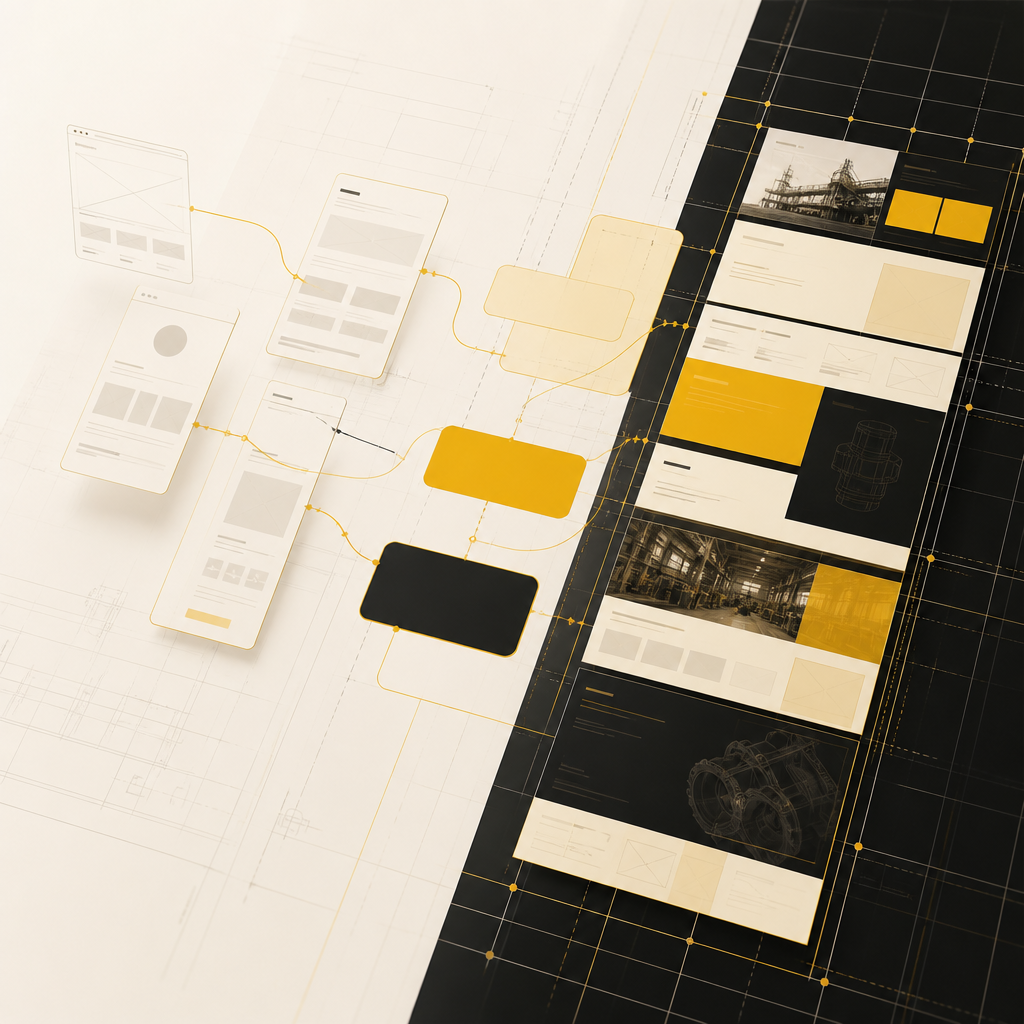
Modern scalable web template concept shown as abstract wireframe blocks and connecting pathways in warm gold and neutral tones.

Web Design & Development as Part of SEO Services

A manufacturing SEO plan often requires site changes. That’s why partnering SEO strategy with development capability can be a major advantage.

SEO-friendly Web Design & Development typically supports:

  • Scalable page templates for capability and product growth
  • Performance improvements that protect rankings
  • Better internal linking structures across templates
  • Accessibility and usability improvements that reduce bounce and improve engagement
  • Clean implementation of tracking and analytics for measurable results

This matters because manufacturers frequently expand services over time. SEO success should not require constant rework—your site should be built to grow.

Typical SEO Services Process (How RTP Delivers SEO for Industrial Teams)

While every engagement differs, the process usually follows this flow:

  1. Discovery & technical assessment
    • Understand your goals, current traffic, and conversion path
    • Review indexing, crawlability, performance, and page structure
  2. Keyword & competitor research for B2B manufacturing intent
    • Build a keyword map for product and capability queries
  3. SEO roadmap and page plan
    • Prioritize what to fix first and what pages to build/optimize to win rankings
  4. On-page and technical implementation
    • Improve page structure, content alignment, internal linking, and technical issues
  5. Content creation or optimization support
    • Create or refine pages based on intent, competitiveness, and conversions
  6. Tracking, analytics, and automation setup
    • Ensure reporting is actionable and tied to lead outcomes
  7. Ongoing optimization
    • Monitor performance, refine keyword targeting, and improve underperforming pages

This combination of SEO + development + operational visibility is designed to keep results improving month after month.

Abstract multi-stage SEO process flow with connected nodes and directional connectors in warm gold accents over an industrial texture background.

What You Can Expect as Deliverables

Depending on your starting point, SEO services for manufacturers typically include:

  • Technical SEO audit and prioritized action plan
  • Keyword research and manufacturing procurement intent mapping
  • On-page optimization recommendations and/or implementation
  • Capability landing page optimization support
  • Internal linking strategy aligned to buyer journeys
  • Structured data recommendations where relevant
  • Analytics and reporting setup (and automation where appropriate)
  • Ongoing optimization based on performance trends

How to Choose the Right SEO Partner for Manufacturing

If you’re evaluating SEO agencies or freelancers, focus on fit—especially for industrial businesses:

  • Industry understanding: Can they map search intent to capability/product decision-making?
  • Technical capability: Do they understand how development affects SEO performance?
  • Clarity and reporting: Can they show what they changed, why, and what improved?
  • Scalability: Can they support expansion of services and landing pages over time?
  • Conversion focus: Do they optimize for leads, not just rankings?

With Shakir Ansari and the RTP team, the advantage is the overlap between SEO Services and Web Design & Development, plus the ability to support scalable workflows through Automation Solutions.

Manufacturing SEO KPIs That Matter

Common performance indicators for industrial SEO programs include:

  • Organic traffic growth (with intent segmentation)
  • Keyword rankings for product/capability terms
  • Click-through rate (CTR) improvements from optimized metadata
  • Indexed and crawl health metrics
  • Lead volume from organic landing pages
  • Engagement metrics on capability pages (time on page, scroll depth where available)
  • Conversion rate and inquiry quality trends tied to SEO pages

A strong SEO program tracks both discovery (rankings/traffic) and outcomes (leads).

FAQs About SEO Services for Manufacturers

1) What makes SEO for manufacturers different from other industries?

Manufacturing SEO must target buyer procurement intent—capability terms, specifications, certifications, industries served, and supplier evaluation needs—then connect those pages to lead capture paths. Technical performance and scalable page structures are also critical for complex sites.

2) Should we create separate pages for each capability or product line?

Usually yes. The best approach is to build/optimize pages that match how buyers search (capability/process/product categories) and then connect them with internal linking. A keyword-to-page map helps prevent overlap and keyword cannibalization.

3) How long does it take to see results from SEO services?

SEO is iterative. Early technical and on-page improvements may impact visibility sooner, while ranking growth for competitive manufacturing terms typically develops over time as content earns relevance and authority.

4) Can technical SEO help if our content is already good?

Yes. Even strong content may not rank if crawling/indexation, performance, internal linking, or structured data are limiting discovery. Technical SEO ensures your best pages can compete.

5) Do Automation Solutions really matter for SEO?

They can. Automation helps monitor issues, prioritize optimizations, streamline reporting, and support faster cycles of improvement—especially when you have multiple products, locations, or teams managing content.

6) How does Web Design & Development impact SEO?

Your site’s structure, templates, performance, navigation, and tracking implementation directly affect search visibility and conversion. Development improvements can make SEO changes easier to scale.

7) What should we prioritize first: technical SEO or content?

Typically, you start with the technical foundation (so pages can be crawled, indexed, and loaded efficiently), then move into intent-focused page optimization and content plans that target procurement keywords.

Conclusion: Build Search Visibility That Converts for Industrial Buyers

For manufacturers and industrial companies, SEO Services should deliver more than rankings—they should create a dependable path from search intent to qualified inquiries. By combining technical optimization, capability-focused content, conversion-minded improvements, and development support through Web Design & Development, your site can become a stronger long-term growth channel.

And with targeted Automation Solutions, your SEO program can stay measurable and scalable as your business expands.

CTA

Explore SEO Services with the RTP team to build an industrial SEO plan that improves visibility for product and capability searches—and converts visitors into leads.